Among the most misunderstood topics in motorhome use — and among those most likely to lead to fines, inspection failures, and insurance disputes — is the regulation governing seat count and seatbelts. Having a table, a bed, a seating group, or a spacious living area inside a motorhome does not mean these spaces are suitable for carrying passengers while the vehicle is moving. What is legally decisive is the number of seats recorded on the vehicle’s registration, whether those seats are technically approved, and whether they are fitted with seatbelts.
This article covers, based on regulation and practice, how many people can legally travel in a motorhome, which seats are accepted as passenger seats, the scope of the seatbelt requirement, rules for child passengers, the inspection and penalty dimension, and the consequences that can arise from an insurance standpoint.
How Is the Legal Number of Passengers Determined in a Motorhome?
The legal number of passengers in a motorhome is determined not by how many people can actually sit inside the vehicle, but by the number of seats recorded on the vehicle’s registration document. This information on the registration is recorded in line with the technical project carried out during the vehicle’s manufacturing or conversion process.
For this reason, cushions added later, side seats around a table, or seating areas created on a bed do not increase the legal passenger capacity of a motorhome unless they are recorded on the registration. The only data used as a basis in inspections and accident assessments is the seat count on the registration document.
- Legal passenger count = number of seats recorded on the registration
- The physical seating area alone is not valid
- Seats added afterward are disregarded if not recorded on the registration
What Does the Seatbelt Requirement Cover?
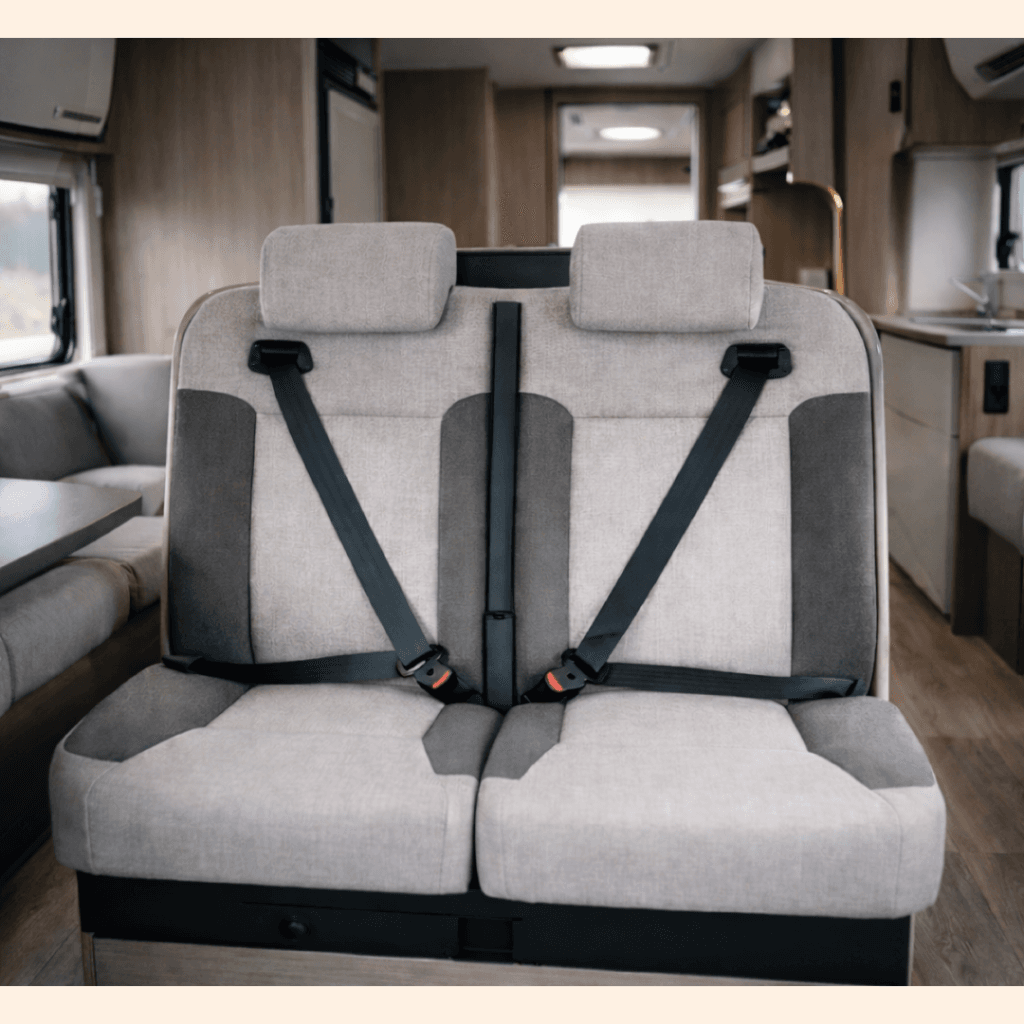
Every passenger seat used while the motorhome is moving must be fitted with an approved, fixed seatbelt. No passenger may be carried in a seat that lacks a seatbelt. This rule does not change based on the seat’s orientation or its position inside the vehicle.
It is not enough for a seatbelt to simply be present. The belt must be properly fixed to the load-bearing structure or chassis and must be used together with a seat suitable for that purpose. Portable belts, belts added afterward, or belts attached only to the body sheet metal are not considered valid under the regulation.
- No passenger may be carried in a seat without a belt
- The belt must be fixed and compliant with the project
- Temporary or portable solutions are not legal
Why Aren’t the Seats Around the Table or Side Seating Areas Counted?
One of the common mistakes made with motorhomes is treating the side seats around the table, or seating groups, as passenger seats. These areas are designed as living space and do not have the structural characteristics needed to ensure passenger safety in the event of a collision.
A legally accepted passenger seat must:
- Be fixed to the chassis or load-bearing frame
- Have sufficient strength to withstand collision loads
- Be fitted with an approved seatbelt
Seating areas that do not meet these conditions can only be used while the vehicle is parked.
Can the Number of Seats on the Registration Be Increased?
It is possible to increase the legal seat count in a motorhome, but this process is not limited to simply adding a seat. It is a technical and official process that requires completing certain steps.
- Preparation of a seat and belt project by an authorized engineer
- Fixing the appropriate seats and belts to the chassis
- Passing a post-modification inspection
- Recording the new seat count on the registration document
Additional seats used without completing these procedures are not considered valid during inspections and can lead to penalties.
Child Passengers and Child Seat Rules
When carrying child passengers in a motorhome, the same child-seat rules that apply to passenger cars are applied. Using a child seat appropriate to the child’s age, weight, and height is mandatory.
However, not every seat in a motorhome is suitable for installing a child seat. Using a child seat on seats without ISOFIX connections or without sufficient structural support is not considered safe. For this reason, if you are planning to travel with children, the technical suitability of the seats should be checked in advance.
Seat Count in Inspections and Traffic Enforcement
During vehicle inspections, the number of seats recorded on the motorhome’s registration is compared against the actual condition. Seats not recorded on the registration, or passenger areas without seatbelts, can lead to inspection failure.
During traffic enforcement, carrying passengers in a manner contrary to the registration can result in an administrative fine for both the driver and the vehicle owner. Passengers may also be required to get out of the vehicle.
The Insurance and Compensation Dimension
Seat count and seatbelt rules are critical not only from a traffic-fine perspective but also from an insurance coverage perspective. Carrying passengers in a way that contradicts the registration can be interpreted by an insurer as “use contrary to regulation.”
Following an accident, this can lead to:
- An increase in the fault ratio
- A reduction in the compensation amount
- Some claims being rejected
For this reason, compliance with seat and belt regulations is directly tied to insurance protection.
The Most Common Mistakes Made in Practice
- Traveling in the seats around the table
- Carrying a passenger in a seat without a seatbelt
- Disregarding the seat count on the registration
- Not having seats added afterward recorded on the registration
- Ignoring child-seat compatibility
Conclusion
How many people can legally travel in a motorhome is determined not by the vehicle’s interior layout, but by the number of seats recorded on the registration and whether those seats are fitted with seatbelts. A seat and belt arrangement that complies with regulation is indispensable, both for passenger safety and for inspection and insurance processes.
Official Sources
- Highway Traffic Regulation (Karayolları Trafik Yönetmeliği) — provisions on seatbelts and seat/passenger capacity
- Law No. 2918 on Highway Traffic (2918 Sayılı Karayolları Trafik Kanunu)
This article was prepared by the CampExpert Editorial Team. Passenger capacity and seatbelt regulations may vary depending on the vehicle’s registration and current regulatory provisions; for exact information, we recommend checking your registration document and current regulation. Last checked: July 20, 2026.
Related Articles
- Legal Requirements for LPG Installations in Caravans
- Are Gas Leak Sensors Mandatory in a Caravan?
- Caravan Registration Types and Legal Limits (Turkey 2026 Guide)
- What’s Excluded From Caravan Insurance
- What Does “Special-Purpose Vehicle” Mean on a Motorhome Insurance Policy?
- Current 2026 Motor Vehicle Tax, Inspection, and Insurance Fees for Caravans