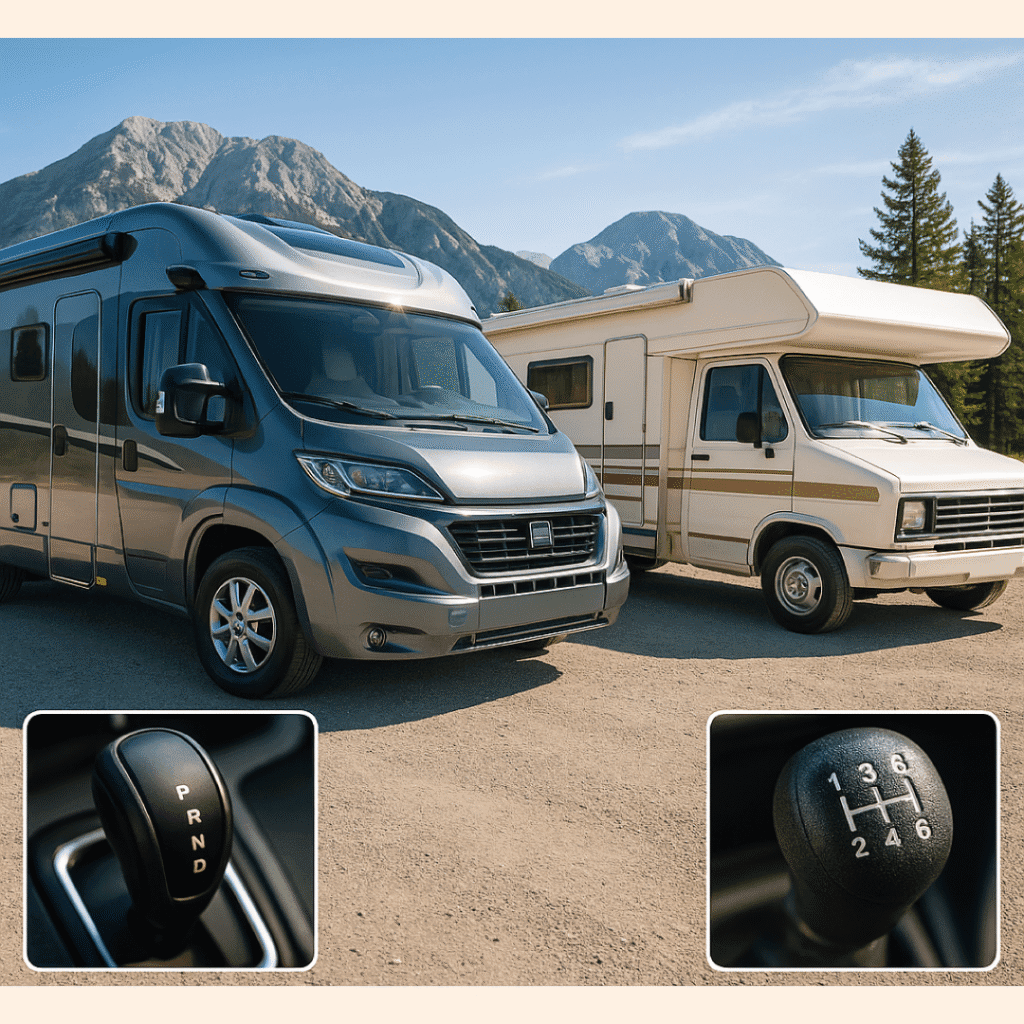
One of the first questions that comes to mind when buying a motorhome is the choice between “automatic or manual?”. This choice directly affects not just driving comfort, but also fuel consumption, long-trip fatigue, potential failure risk, maintenance costs, and resale value. In this comprehensive guide we examine both systems from a technical and practical angle, then summarize the automatic transmission options in the Fiat Ducato, Mercedes-Benz Sprinter, Volkswagen Crafter, Ford Transit, and Iveco Daily — the base vehicles most commonly used for motorhomes in Europe.
Why Is the Transmission Choice Critical?
Motorhome use covers varied routes: highways, stop-and-go city traffic, mountain roads, coastal routes… The transmission type determines how well the vehicle adapts to these varying conditions, how engine torque is delivered to the road, and how tired the driver feels by the end of the day. The service network, parts availability, and resale value are also affected by the transmission choice.
Automatic Transmission Motorhomes
Modern automatic transmissions (like the 9G-TRONIC, ZF 8HP-based systems, Aisin 8-speed, and Ford’s 10-speed) have moved far past the old “guzzles fuel, overheats quickly” perception; thanks to multi-ratio gear sets and smart software, they offer both comfort and efficiency.
Advantages
- Comfort: No clutch and constant gear shifting; major relief on long trips and in city traffic.
- Hill starts and climbing: Safe driving with anti-rollback systems and correct ratio selection.
- Less driver fatigue: Attention stays on reading the road and controlling speed.
- Good for newer drivers: Risks like stalling or selecting the wrong gear are minimized.
- Resale appeal: Since demand is high, the selling process is usually faster.
Disadvantages
- Purchase cost: Usually more expensive than the manual version with the same equipment.
- Maintenance/repair expense: ATF fluid changes and mechatronic/valve body failures can be more costly.
Failure Risks (Automatic)
Automatic transmissions are electronically-hydraulically complex systems. The mechatronic module, torque converter, and valve body are the most sensitive components. If ATF change intervals are followed, heat management is done properly, and additional cooling solutions are used under heavy towing, the lifespan can comfortably exceed 1,000,000 km.
Manual Transmission Motorhomes
Manual transmissions are mechanically simple with controlled service costs. Since the driver directly controls gear selection, the “sense of control” is higher in some demanding conditions. That said, driving comfort in heavy traffic and on long trips isn’t as strong as with an automatic.
Advantages
- Lower cost: Purchase and typical maintenance/repair expenses are more economical.
- Mechanical simplicity: Few electronic components; failures are usually predictable and quick to fix at a shop.
- Precise control off-road: Direct control over gear selection, especially on technical climbs and descents.
Disadvantages
- Comfort limitation: Fatigue increases in stop-and-go traffic and on long drives.
- Disadvantage in resale speed: As market demand shifts toward automatics, sale time can lengthen.
Failure Risks (Manual)
The most common issues are clutch disc/pressure plate wear, synchronizer issues, and clutch hydraulic leaks. Parts and labor costs are generally lower than for an automatic transmission; however, aggressive use can quickly wear out clutch life.
Fuel Consumption: How Big Is the Difference?
In the past, automatics consumed noticeably more fuel; today, with modern multi-ratio automatics, the difference has dropped to 3-5% in most matchups. In some engine-transmission combinations, the difference is nearly negligible.
| Transmission Type | Average Consumption (100 km) | Practical Note |
|---|---|---|
| Automatic | 9.8-10.5 L | The difference is minimal in most scenarios with 8-10 speed automatics |
| Manual | 9.5-10.2 L | A slight advantage with the right gear and RPM |
Which Brand and Transmission Is Higher Quality/Safer?
The summary below gives the automatic options and a short character profile for the models most commonly chosen as motorhome bases. On the safety side, remember that each model’s active safety/ADAS packages can vary depending on the trim level.
| Base Vehicle | Automatic Transmission | Short Character |
|---|---|---|
| Fiat Ducato | 9-speed AT | Comfort-focused, torque management via drive modes; very common in the European market |
| Mercedes-Benz Sprinter | 9G-TRONIC | Smooth shifting, wide ratio range; advanced ADAS options |
| Volkswagen Crafter | Aisin 8-speed | A balance of efficiency and durability; known for reliability |
| Ford Transit (RWD) | 10-speed AT | Strong towing capacity and ratio spread; performs well under heavy use |
| Iveco Daily | Hi-Matic (ZF 8HP) | Mature ZF-based architecture; high torque durability and smooth shifting |
Quick take: For comfort and long-trip focus, the Sprinter 9G-TRONIC and Iveco Daily Hi-Matic (ZF 8HP) are mature, smooth options. The Ducato’s 9-speed has a service/experience advantage since it’s so widely used as a motorhome base in Europe. The Crafter’s Aisin 8-speed stands out for reliability, while the Transit’s 10-speed stands out for heavy towing and ratio variety. The final decision should factor in the use case (load, route, towing), proximity to service, and budget.
General Comparison Table
| Criterion | Automatic | Manual |
|---|---|---|
| Comfort (city + long trip) | ✅ Very high | ⛔ Lower |
| Fuel consumption | ✅ Close to manual (~3-5%) | ✅ Slight advantage |
| Maintenance/repair cost | ⛔ Higher | ✅ Lower |
| Failure complexity | ⛔ Electronic-hydraulic | ✅ Mechanical and predictable |
| Resale value | ✅ Strong demand | ⛔ Sells more slowly |
| Off-road/incline control | ✅ Successful in newer generations | ✅ Precise control |
Which Transmission for Which User?
- Frequent travel + city traffic: Automatic; fatigue and stress drop noticeably.
- Budget sensitivity + simplicity: Manual; lower purchase and maintenance cost.
- Heavy towing/hilly routes: Both systems work; heat management and maintenance are critical for automatics, clutch use is critical for manuals.
- New/sole driver: Automatic; lower margin for error, easy to use.
Summary: For general use, automatic stands out for comfort and today’s consumption figures. Manual is still a very valid option for users who prioritize cost and mechanical simplicity.
Frequently Asked Questions (FAQ)
Is fuel consumption in an automatic motorhome noticeably higher than a manual?
No. In modern 8-10 speed automatics the difference is in the 3-5% range in most scenarios; in some combinations it’s nearly equal.
Which transmission is more reliable?
“Reliability” is tied to use and maintenance. As mature architectures, ZF 8HP (Iveco Hi-Matic), 9G-TRONIC (Sprinter), and Aisin 8-speed (Crafter) have proven themselves widely in the field. They’re long-lived when periodic maintenance discipline is followed.
Does a manual transmission last longer?
Since it’s mechanically simple, its lifespan can be long; but clutch usage habits directly affect longevity. Aggressive use in heavy traffic quickly wears out the disc/pressure plate.
Which makes more sense for long trips?
For most users seeking comfort and low fatigue, automatic makes more sense. For cost-focused, calm driving, manual can also be considered.
Is towing capacity related to transmission choice?
Yes. For automatics, the ratio range, torque converter lockup, and heat management matter; for manuals, clutch and gear ratios are critical. In a constant heavy-towing scenario, proper equipment and periodic maintenance are essential.
Conclusion
For those prioritizing comfort + ease of use, automatic is the rational choice; for those prioritizing cost + simplicity, manual is. Whichever base you choose, weigh your decision alongside the service network, spare-parts access, warranty terms, and current driver-assistance packages. But we can comfortably say the future is Automatic.