2026 Updated Guide. If you’re going to tow a caravan or trailer, the tow bar is at the heart of the job. In this article we cover what a tow bar is, its types, installation steps, wiring (7/13 pin), costs, and the legal procedure in Turkey — step by step, with examples.
What Is a Tow Bar?
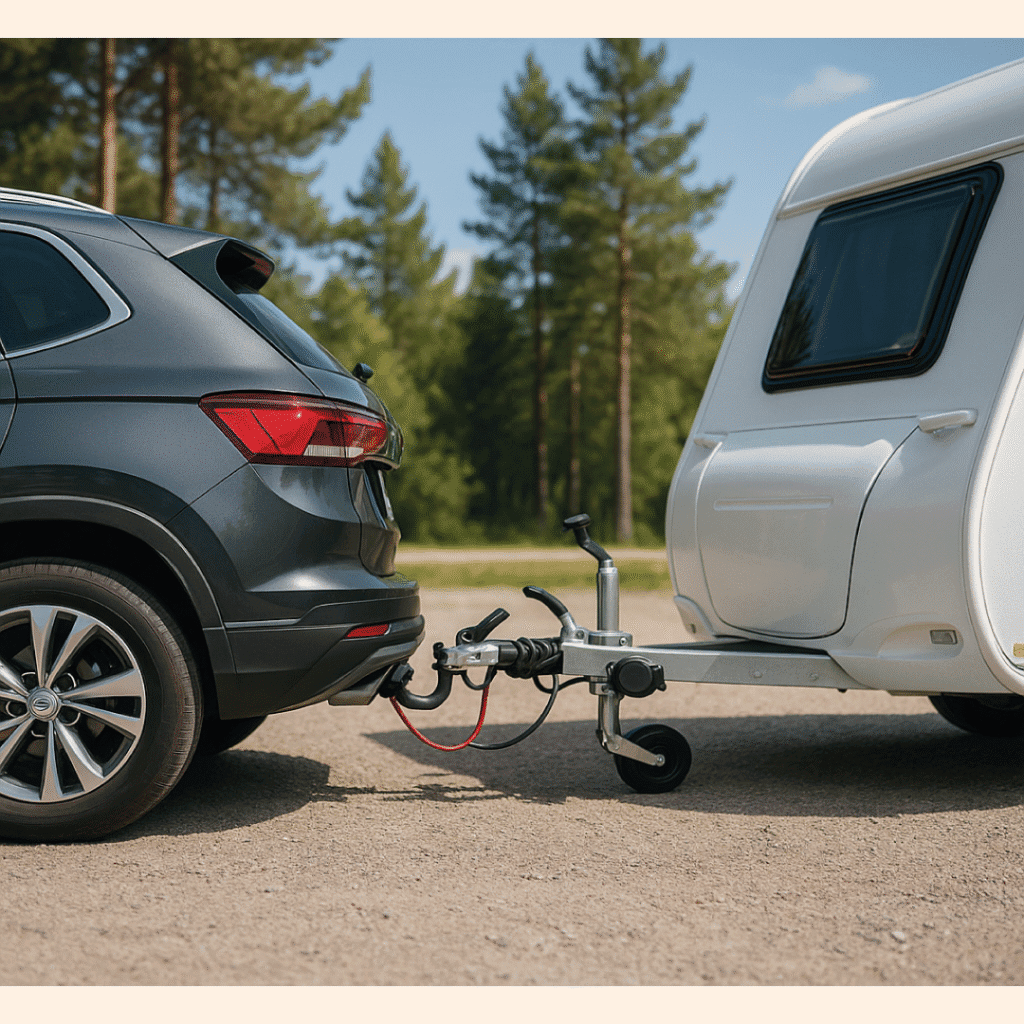
A tow bar is equipment attached to a vehicle’s chassis/load-bearing points that allows a caravan, trailer, boat trailer, or carrier attachment to be safely mounted at the rear. For legal use in Turkey, the tow bar must hold ECE R55 (E/e-marked type approval) certification, and installation must be done at an authorized/qualified facility. Installation isn’t just mechanical — the 7 or 13 pin electrical wiring must also work correctly per regulation for lighting and additional functions (reverse, fog, caravan interior equipment, etc.).
Types of Tow Bars
| Type | Advantages | Disadvantages | Best For |
|---|---|---|---|
| Fixed | Economical, durable, easy maintenance | Always visible; can affect parking sensors on some vehicles | Drivers who tow routinely |
| Detachable (modular) | Attach/remove as needed; sensor and appearance friendly | More expensive; locking mechanism needs maintenance | City driving + occasional towing |
| Retractable/swan-neck | Practical; hidden design | Highest cost; complex mechanism | Premium vehicles, OEM-fit seekers |
| Heavy-duty/off-road | High D-value, reinforced crossmember | Heavy and expensive | 4×4, off-road trailer/overland towing |
Wiring: 7 Pin or 13 Pin?
A 7-pin harness meets the minimum requirement for trailer lighting. The 13-pin system is the standard preferred by caravan users; it supports reverse light, fog light, extra ground, charging line, and fridge and other living functions. Modern vehicles require CAN-bus compatible bypass modules; incorrect wiring can cause faults and inspection failures.
Choosing the Right Product (Checklist)
- Kit specific to your vehicle make/model/chassis code (OEM-compatible geometry)
- ECE R55 type-approved product (E/e mark, plate/label)
- TSE-approved installation and compliance with the Installation Conformity Report process
- CAN-bus compatible wiring kit, check if a 7→13 pin adapter is needed
- D-value, maximum vertical load (S-value), and towing capacity suited to your vehicle
Installation and Legal Procedure: Step by Step
- Assessment & product selection: Chassis points, exhaust/bumper, parking sensors, spare wheel and bumper fit are checked. An ECE R55-certified kit and 7/13-pin wiring are selected.
- Mechanical installation: Mounted at the manufacturer-specified attachment points to the correct torque values; the capacity label is placed in a visible position.
- Electrical wiring: Modules and cabling are routed with protection against short circuits and CAN faults. For 13-pin, a permanent fused +12V (10-15A) and charging line are run.
- Light testing: Park, brake, signal, fog, and reverse functions are tested with the trailer attached. Fault-detection errors are resolved.
- TSE application: An application for TSE Installation Conformity is filed with the authorized service’s documents; the vehicle is inspected at a TSE Vehicle Inspection Center.
- Approval & QR code: Once conformity is approved, an e-signed/QR-coded document is issued.
- Notary/registration: With the QR-coded document, the notary enters “A tow bar has been fitted to the vehicle” into the “Other Information” section of the registration.
- Inspection & insurance: Checked at the periodic vehicle inspection; notifying your comprehensive and third-party insurance is recommended.
Costs (2026 Updated Ranges)
| Item | Economy | Mid-range | Premium |
|---|---|---|---|
| Tow bar kit (fixed) | 9,000–16,000 TL | — | — |
| Tow bar kit (detachable/retractable) | — | 18,000–28,000 TL | 32,000–45,000 TL |
| Installation labor | 6,000–8,000 TL | 8,000–10,000 TL | 10,000–14,000 TL |
| Wiring (7/13 pin, socket) | 4,000–5,000 TL | 5,000–7,000 TL | 7,000–10,000 TL |
| TSE Project Approval | 5,412 TL (fixed 2026 fee) | ||
| Registration entry (notary) | 1,968 TL (fixed 2026 fee) | ||
| Total (typical range) | 25,000–35,000 TL | 38,000–52,000 TL | 55,000–75,000 TL |
Note: Prices vary by vehicle type (car/SUV/light commercial), OEM vs. aftermarket choice, cable kit, and labor hours; regional (Anatolia/Istanbul) differences may apply. The TSE project approval (5,412 TL) and notary registration fee (1,968 TL) are fixed official 2026 tariffs.
O1–O2 Class Trailers/Caravans and Registration in 2026
Class O1 refers to trailers/caravans with a maximum mass of 750 kg or less; O2 refers to those between 750–3,500 kg. Under current regulation: O1-class trailers/caravans manufactured from January 1, 2025 onward must be registered through the ARTES system and receive an independent license plate, subject to annual vehicle inspection. O1 vehicles manufactured before January 1, 2025 may continue to be used on the road under the towing vehicle’s plate until January 1, 2035; after that date, unregistered O1 vehicles will be barred from traffic. A standard Class B driving license is sufficient for towing. A vehicle with a tow bar fitted is checked for lighting/connection components and labeling at inspection.
Practical Tips (Safety & Use)
- The breakaway cable must be routed to the correct point — attach it to a fixed ring on the chassis, not the hitch body.
- Ball/hitch and coupling compatibility: check the 50mm standard and wear tolerance; if there’s play or “rattle,” have it serviced.
- Read the D-value/S-value label; verify your caravan’s nose weight with a scale (typically 50–100 kg for most passenger cars).
- Electrical: if using 13-pin, fuse the fridge/charging line; plan the permanent +12V cable independently of the ignition.
- Maintenance: keep the locking detachable mechanism dry; have corrosion and torque values checked annually.
Frequently Asked Questions
Can a tow bar be fitted to any vehicle?
Some models without manufacturer towing approval, or with battery/exhaust packages, may not have a compatible kit available. Check based on your chassis number.
Can it be added to the registration without TSE approval?
No. A notary change cannot be made without TSE Installation Conformity approval and a QR-coded document.
Do O1 caravans no longer need a plate?
O1 vehicles manufactured after January 1, 2025 require registration and an independent plate through ARTES. Those manufactured earlier have a transition period until January 1, 2035.
Is insurance notification required?
Third-party liability insurance does not cover the tow bar; requesting an additional clause on your comprehensive policy is recommended.
Conclusion
For safe and legal towing, you need an ECE R55-certified tow bar, qualified installation, TSE approval, and completion of the registration chain. For caravan users, a 13-pin harness, a braked coupling, and correctly set nose weight noticeably improve driving stability. With proper planning, all steps from installation to registration can be completed within 1-5 business days.
Official Sources
This article is prepared by the CampExpert Editorial Team. Last checked: July 20, 2026. Prices and regulatory information are based on market observations and current regulations; TSE and notary fees are official tariffs, other costs may vary. We recommend confirming with an authorized service and a TSE Vehicle Inspection Center before proceeding.
Related Articles
- Caravan Tires: Pressure, Maintenance, and Replacement Timing Guide (2026)
- Motorhome Driving Techniques: Parking, Narrow Roads, and Driving in Windy Weather