
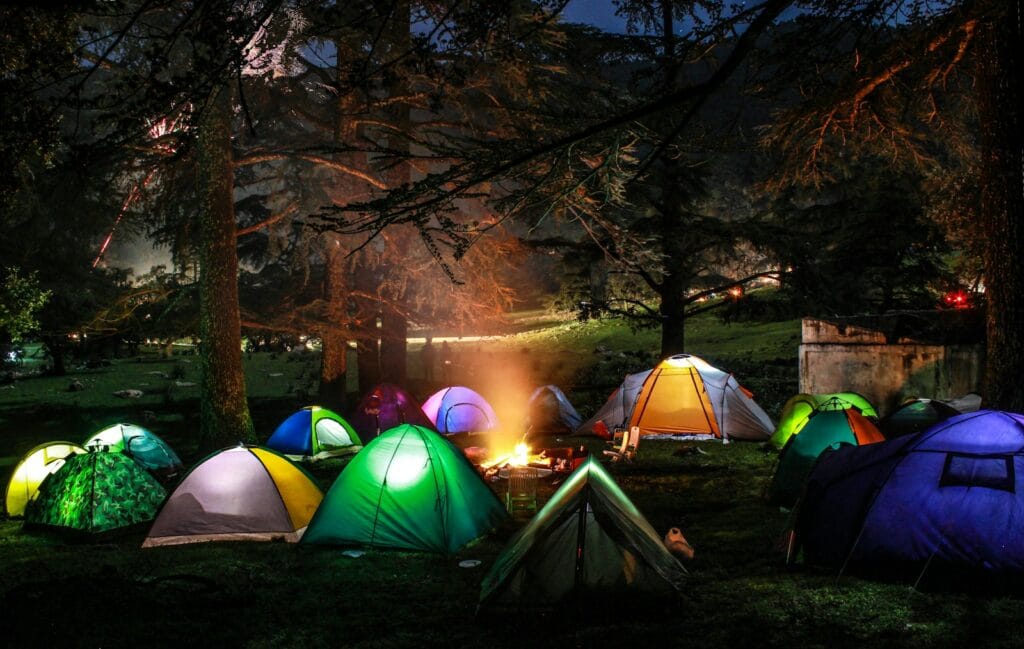
Smart campgrounds are becoming the norm, connected much like smart homes. In 2026, a wave of smart campground technology — from motion-activated smart lighting to environmental monitoring sensors, digital check-in systems to EV charging stations — is fundamentally reshaping the camping experience. For campground operators, this is no longer an “extra” feature; it’s become a baseline part of guest expectations. Here’s where smart campground technology stands in 2026.
Smart Lighting and Safety
Smart lighting systems that operate automatically based on motion detection and ambient outdoor light conditions are becoming widespread across campgrounds. By activating only when needed, these systems save energy while creating a safer nighttime environment. Automatically lighting up a walking path in a dark campground is a practical safety improvement, especially for families camping with children or anyone making a nighttime trip to the restroom.
Connected IoT infrastructure enables wireless connectivity across campsites, giving campers easier access to a range of smart devices and making the overall experience more convenient. That means a campground is no longer just a physical space — it’s becoming a digitally managed service network too.
Environmental Monitoring: From Weather to Air Quality
Connected sensors now collect data on weather patterns, air quality, noise levels and more, giving campers valuable insight into their surroundings while also promoting more sustainable practices. A campground operator can use this data to, for example, impose a fire restriction during a high-risk dry spell, or notify guests on days when air quality drops.
Smart tent technology is part of this same trend: modern smart tents now include sensors that track temperature, humidity and air quality, Wi-Fi connectivity, and automation systems that let users control various aspects of the tent from their smartphone. Some models use AI-assisted weather tracking to alert campers to storms or sudden temperature swings in real time.
From Booking to Payment: Digital Operations
Digitization is accelerating on the operations side too. Online booking, digital check-in, mobile-friendly site maps and automated payment processing have become the baseline expectation for campers in 2026. That marks a shift away from the traditional “paper sign-in at the front desk” model toward a digital guest experience more comparable to a hotel’s.
Wi-Fi, meanwhile, has stopped being a luxury and become a deciding factor in choosing a campground. Nearly half of new campers consider Wi-Fi the most important factor when picking a campground, and Gen Z campers report they’ll spend nine extra days camping when they have access to technology. That data point shows that wanting to disconnect is no longer a universal motivation for camping — for some campers, the ability to stay connected directly influences whether they go camping at all.
EV Charging: A New Standard in the Making?
80% of campers who own or plan to own an electric vehicle say they want to use it for camping, including car camping and glamping. Roughly a quarter of campers (24%) already own an EV, compared to just 4% among non-camping leisure travelers — showing that EV adoption among campers runs notably higher than in the general population. 40% of EV-owning campers say they’re more likely to choose a campground that offers charging stations.
Supply still hasn’t caught up with demand, though: even among major campground chains, only a small fraction currently offer EV charging infrastructure. That suggests EV charging infrastructure will be one of the biggest investment opportunities for campground operators over the next few years — much like the race hotels ran to install charging stations a few years back.
The Data Question: What Are Campgrounds Actually Collecting?
Every sensor, booking system, and connected device that makes a campground “smart” is also a data collection point, and the industry hasn’t fully reckoned with what that means yet. Broader survey data shows concern about data protection rose from 26% in 2022 to 29% in 2026 among consumers generally, while concern about surveillance climbed from 16% to 19% over the same period. More strikingly, 55% of respondents in a 2026 survey said they have little to no understanding of how their data is actually used by the connected devices they interact with — a transparency gap that applies just as much to a smart campground’s Wi-Fi login and check-in kiosk as it does to a smart thermostat at home.
Campground operators adopting this technology are also inheriting a vendor-risk problem that’s bigger than any single system. Most privacy regulations now hold businesses responsible for how their third-party providers — cloud hosting, payment processing, booking platforms, analytics vendors — handle the personal data collected on their behalf, which means a campground’s data exposure isn’t limited to its own systems but extends to every vendor in its technology stack. For an industry that’s historically run on a paper sign-in sheet and a cash box, that’s a meaningfully higher bar of operational responsibility than most operators were prepared for even a few years ago.
The Business Case: Why Operators Are Investing Anyway
Despite the privacy overhead, the operational case for smart campground technology keeps getting stronger. The outdoor hospitality industry has gone through more technological change in the last five years than in the previous twenty, a shift accelerated first by pandemic-era demand for contactless operations and now sustained by rising labor costs that make automation less of a luxury and more of a necessity. Campground analytics tools have matured accordingly: operators today have access to revenue-per-available-site (RevPAS) tracking, booking-pace comparisons against prior years, marketing source attribution, and guest lifetime value metrics — the same category of data-driven decision-making that hotel chains have relied on for years, now available to a single-property campground operator.
That combination — real operational upside paired with a genuine, still-unresolved privacy question — is likely to define how smart campground technology develops over the next few years. Operators who invest in these systems while being transparent with guests about what’s collected and why are likely to build more durable trust than those who treat connectivity purely as a competitive feature to advertise.
What Campers Should Actually Look For
For a camper choosing between properties, the practical question isn’t whether a campground has “smart” features in the abstract, but which specific features actually improve the stay versus which exist mainly as a marketing checkbox. Reliable Wi-Fi and straightforward digital check-in solve real friction points — arriving late at night to a locked office, or losing signal mid-workday, are genuinely disruptive. EV charging availability matters enormously to the growing share of campers who own or are considering an electric vehicle, and is worth confirming directly before booking rather than assuming, since availability still lags demand industry-wide. Environmental sensors and automated fire-restriction alerts, meanwhile, are more of a background safety benefit than something a guest interacts with directly, but they’re a meaningful sign that an operator is investing in guest safety rather than just guest-facing convenience.
On the privacy side, a reasonable habit for campers is the same one that applies to any connected service: check whether a campground’s booking platform or app has a visible privacy policy, be cautious about how much personal information a digital check-in kiosk requests beyond what’s legally necessary, and treat campground Wi-Fi the way you’d treat any public network — useful for browsing, but not the place to handle sensitive personal or financial information. As smart campground technology keeps spreading, that kind of basic digital hygiene is likely to become as standard a part of trip preparation as checking the weather forecast.
The Road Ahead: What’s Next for Smart Campgrounds
In the near term, the fastest-moving areas of smart campground technology are likely to be integration and personalization. Today, most campgrounds run separate, disconnected systems for lighting, booking, payment, and environmental monitoring; over the next few years, expect these to consolidate under a single central platform that adapts automatically to a guest’s preferences — arrival time, vehicle type, EV charging needs, and so on. That mirrors the transformation major hotel chains went through with guest-profile technology roughly a decade ago, now arriving in the campground sector.
In the medium term, environmental sensor data is likely to be surfaced directly to guests rather than staying purely operator-facing — for example, letting a camper check expected air quality, noise levels, or fire-risk conditions for a specific date before booking. That kind of transparency would both improve the guest experience and make it easier for operators to justify why the data is being collected in the first place, since it would deliver a concrete benefit to the guest rather than only the business. How well the industry strikes that balance will do a lot to determine how quickly smart campground technology gets adopted from here.
Conclusion: The Campground as a Digital Service Point
In 2026, a campground is no longer just a plot of land and a power outlet — it’s a connected service point equipped with smart lighting, environmental sensors, digital booking-and-payment infrastructure, and increasingly common EV charging stations. The driving force behind this shift is clear: campers still want to escape into nature, but they’re no longer willing to fully give up safety, comfort and connectivity to do it. For campground operators, that means investing in technology is no longer an optional extra — it’s becoming a prerequisite for staying competitive.
Sources: CRR Hospitality, Firefly Reservations, KOA Camping Blog, RV PRO, Modern Campground, Bivocom and various industry sources, July 2026.