For years, winter camping was seen as the domain of a small circle of experienced mountaineers and extreme-weather enthusiasts. That’s changing fast in 2026: storm-ready four-season tents, phase-change sleeping systems, jacket fabrics with better warmth-to-weight ratios, and voice-controlled lighting are making winter camping a far more accessible experience. Here’s what stands out in 2026’s winter camping gear and technology.
Storm-Ready Four-Season Tents
Durability is the headline theme in the 2026 four-season tent segment. The Simond Makalu T2 mountaineering tent — sold in Turkey through Decathlon stores and decathlon.com.tr — is a genuinely accessible four-season option, built for high-altitude conditions with a wind-resistant design. On the more budget-friendly end, Decathlon’s Quechua four-season (MH series) tents, with insulated fabric, are an entry point that’s actually easy to find in Turkey for campers trying winter camping for the first time.
What these tents share is steeper pole angles, tougher fabric weaves, and geometric shapes that shed snow load better than traditional three-season designs. Steeper roof pitches to prevent snow accumulation and aerodynamic profiles that reduce wind load are among the core engineering differences that separate four-season tents from three-season models.
Next-Generation Insulation in Sleep Systems
Sleeping bag technology is advancing too. Decathlon’s Forclaz line of down sleeping bags, sold in Turkey, spans a range of comfort ratings (the MT500 series down to about -5°C, the MT900 series with down fill) covering a wide range of winter camping conditions; water-resistant outer fabric and compressible packing deliver a better-than-expected warmth-to-weight balance at this price point.
Sleeping pads are seeing similar progress: Decathlon’s Forclaz self-inflating and inflatable pads, available in Turkey, are graded by R-value: for four-season and harsh winter use, look for R 4 and above, since lower-R models are really only suited to spring/summer/fall. A sleeping pad’s R-value — its thermal resistance rating — plays a role just as critical as the sleeping bag itself when it comes to blocking cold rising from the ground.
Winter-Specific Tech: Voice Control and Smart Materials
Smart features are spreading through winter camping gear too. A voice-controlled lantern can be switched on and off, dimmed, and set to different modes with spoken commands like “coast on” or “coast red” — a practical solution when fumbling for tiny buttons with gloved hands in winter conditions. USB-C rechargeable, these lanterns can offer up to 16 hours of runtime on a single charge.
Materials science is advancing on the outerwear side as well. Columbia’s Omni-Tech and OutDry winter parkas — sold in Turkey via columbia.com.tr, Trendyol, and Amazon.com.tr — balance waterproofing and breathability with modern fabrics, and their lightweight, packable insulation options are a practical, accessible alternative. Fabrics like this are narrowing the traditional trade-off between durability and packability in winter camping gear.
Winter Camping in an RV: Heating and Freeze Protection
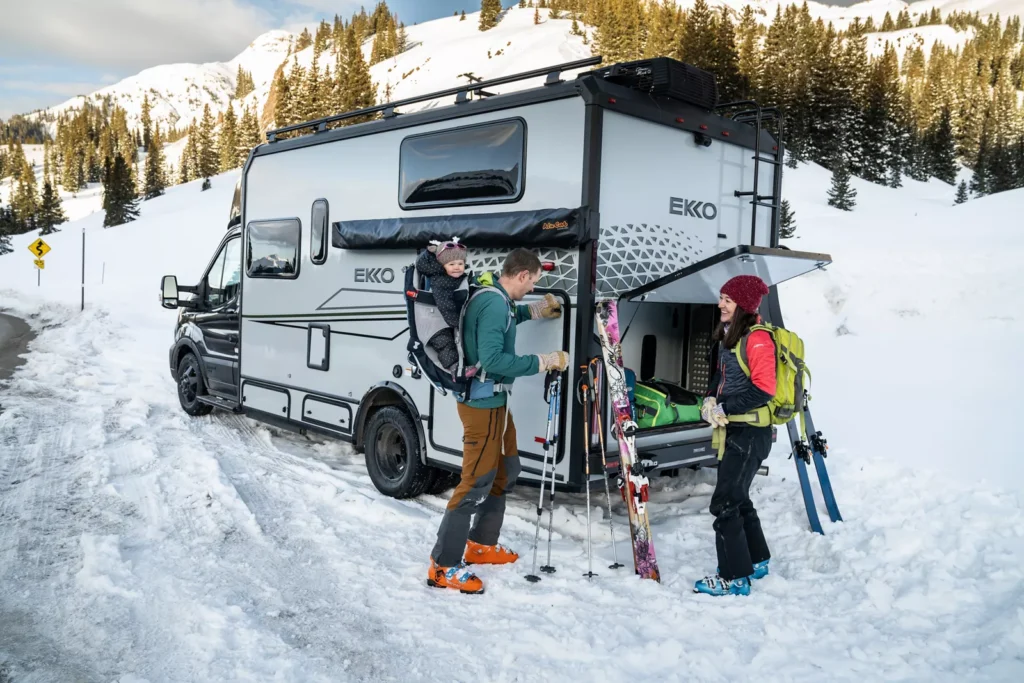
Moving from tent camping to RV camping, winter’s biggest engineering problem becomes heating and preventing the water system from freezing. Four-season packages on 2026 model RVs are becoming more effective through better body and underbelly insulation, heat-taped water tanks and pipes, and the pairing of LP gas heaters with electric heat pumps. The spread of lithium batteries and solar panels is also making it easier to run heating systems during winter camping without relying on a generator — especially on cold but sunny days.
There’s also a notable technology transfer happening between four-season tent camping and RV camping: phase-change materials (PCM) and advanced insulating fabrics are first tested in technical clothing and tents, then adapted for RV interior insulation.
Safety First: Hypothermia and Frostbite
Better gear doesn’t eliminate winter camping’s core dangers — it just makes them more manageable. The greatest risks in a winter environment remain hypothermia and frostbite, and both require proper trip planning, experience, and the right equipment to avoid. Hypothermia sets in gradually and often subtly: shivering, slurred speech, and fumbling hands are early warning signs that are easy to dismiss as “just being cold” until the situation has already become dangerous. Frostbite tends to strike extremities first — fingers, toes, ears, and the nose — and can occur faster than most campers expect, particularly in wind chill conditions that feel colder than the actual air temperature suggests.
The practical defenses against both are the same fundamentals experienced winter campers repeat every season: never camp in cotton, which retains moisture and accelerates heat loss; carry more insulating layers than you think you’ll need; know your and your group’s early symptoms; and always camp with a plan for how to bail out if conditions turn. No amount of high-tech fabric or app-connected gear substitutes for those basics — the technology in this article is best understood as risk-reduction on top of solid winter camping fundamentals, not a replacement for them.
Cooking Gear: Why Your Summer Stove Won’t Cut It
One of the most common mistakes first-time winter campers make is bringing the same canister stove they use in summer. A standard canister stove can struggle badly in freezing temperatures because cold canisters depressurize and produce a weak, unreliable flame right when you need hot food and water the most. Campers who want to stick with a canister system should look for one with a built-in pressure regulator, which helps counteract that depressurization effect; an alternative is switching to a liquid-fuel stove, which handles cold weather more predictably than canister systems overall.
Keeping the fuel source warm matters just as much as the stove itself. Experienced winter campers typically stow their fuel canister inside their sleeping bag overnight and tuck it into a jacket pocket close to the body while setting up to cook, using body heat to keep the canister’s internal pressure high enough to perform. It’s a low-tech trick, but it remains one of the most reliable ways to guarantee a working stove on a cold morning, regardless of how advanced the stove itself is.
Footwear and Layering: The Foundation Under Everything Else
Footwear is arguably the most critical, and most commonly under-budgeted, item on a winter camping gear list. Boots need to be insulated, waterproof, and have good traction for snow-covered and icy terrain — and experienced winter campers often recommend sizing up slightly from your regular shoe size. That extra room isn’t about comfort alone; it allows for layered socks and creates a pocket of dead air between the foot and the boot that acts as an additional layer of insulation, since air trapped and warmed by the body insulates far better than a tightly packed boot ever could.
The same logic extends to the rest of a winter layering system: a moisture-wicking base layer, an insulating mid-layer, and a waterproof-breathable outer shell work together to manage both cold and the sweat generated by activity, since wet insulation loses most of its warming ability. Combined with a genuinely four-season-rated shelter and a sleeping pad with an adequate R-value, this layering discipline forms the non-negotiable foundation that every piece of newer winter camping technology in this article builds on top of — not a substitute for it.
Building a First Winter Kit Without Overspending
For someone assembling their first winter camping kit, the temptation is to buy everything at once at the top of each category — but experienced winter campers generally recommend a different sequencing. The shelter and the sleeping system come first, since they’re the two items where a failure is genuinely dangerous rather than merely uncomfortable: a three-season tent in a real winter storm, or a sleeping bag rated well above the night’s actual low temperature, can turn a minor cold snap into an emergency. A four-season tent and a bag rated with a comfortable margin below the coldest temperature you expect to encounter are worth prioritizing over every other item on the list.
Everything else can reasonably be upgraded over time. A budget canister stove with a pressure regulator will get a first-timer through most three-season-adjacent winter trips before a liquid-fuel stove becomes necessary for deep-winter or high-altitude use. Layering pieces can be built up piece by piece rather than bought as a complete system in one trip to the store, and a smart lantern or voice-controlled lighting, while genuinely convenient, sits firmly in the “nice to have” category rather than the safety-critical one. Spending the first season’s budget on shelter and sleep system, then filling in the rest of the kit as experience clarifies what a given camper actually needs, tends to produce both a safer and a more cost-effective outcome than trying to buy a complete kit before ever setting foot in the snow.
Conclusion: Winter Camping Is No Longer Just for Experts
2026’s winter camping gear is taking the experience out of the hands of a small circle of expert mountaineers and opening it up to a much broader audience. Lighter, tougher four-season tents, sleep systems with better warmth-to-weight ratios, glove-friendly smart lighting, and improving freeze-protection technology in RVs combine to make winter outings far less risky and far more comfortable than they used to be. For anyone planning a winter trip by RV or tent, the two most critical investments remain the same: a sleeping pad with the right R-value, and a shelter that’s genuinely rated for four-season use.
Sources: GearJunkie, CleverHiker, Backpacker, Outside Online, Engearment, KOA Camping Blog and various industry sources, July 2026.