Ventilation doesn’t get talked about as much as insulation or wiring, but it’s one of the most critical factors for comfort, health, and moisture control in a caravan. Poorly designed airflow comes back to bite you as fogged-up windows, heavy condensation, mold, stale odor, headaches, and poor sleep. In this guide, we cover roof fan selection, vent placement, passive ventilation, condensation control, and how popular fans like Maxxair, Fiamma, and Dometic actually work, all in line with 2025 conditions.
This article is a thorough, practical roadmap both for people building a new caravan and for those who want to improve ventilation in their existing one.
1. Why Is Ventilation So Important in a Caravan?
A caravan behaves like a small metal box. People breathing inside, cooking, running the stove, and showering all constantly produce moisture and carbon dioxide. If that air isn’t refreshed:
- Windows and ceiling panels fog up
- Condensation forms on walls and in corners
- Mold and odor start around the fridge and kitchen cabinets
- Oxygen drops while you sleep, and you may feel headaches and fatigue
A good ventilation system needs to:
- Expel damp, stale air from inside
- Draw in fresh air from outside
- Run as quietly as possible
- Keep power consumption at a reasonable level
2. The Roof Fan — The Heart of Caravan Ventilation
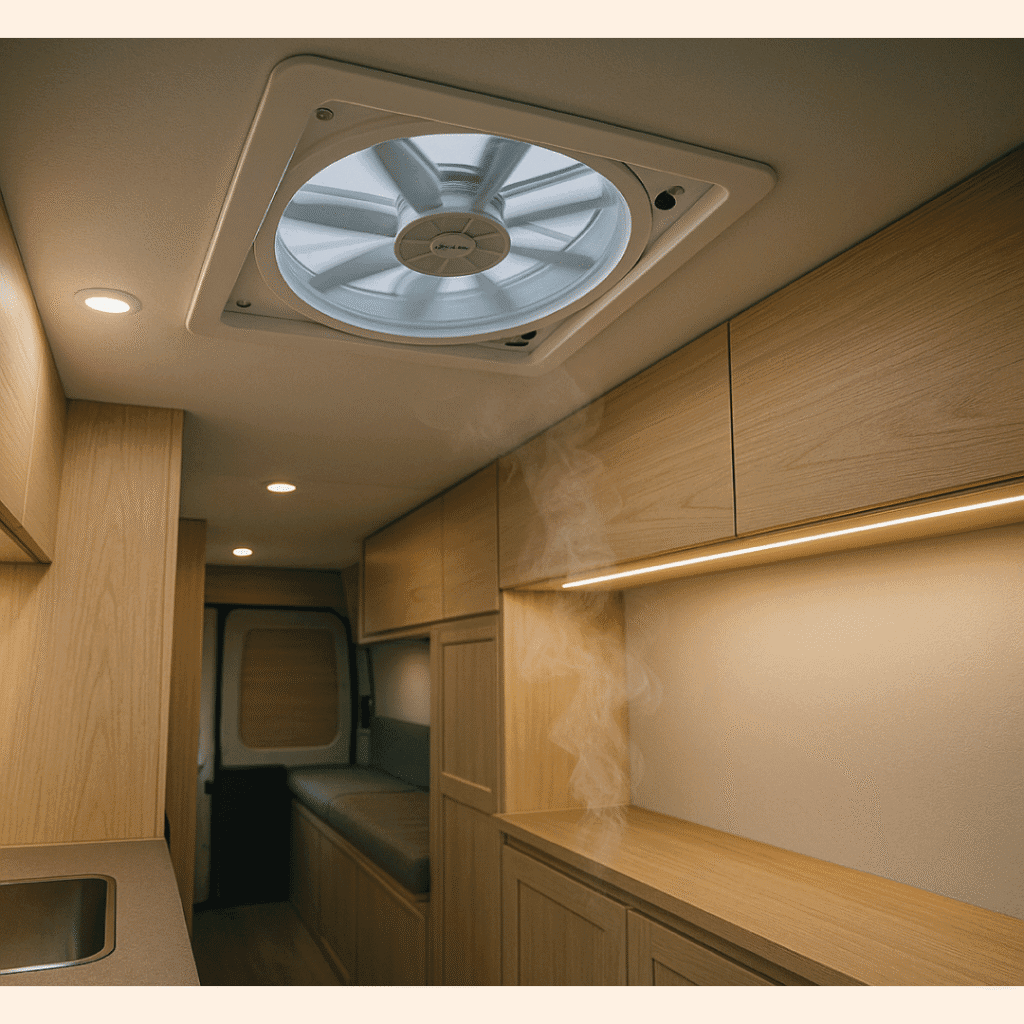
Almost every modern caravan has at least one roof fan. It’s used not just for summer cooling but for moisture and odor control all year round.
2.1 Popular Roof Fan Brands
- Maxxair (MaxxFan Deluxe, etc.)
- Dometic (fans bundled with the FreshJet series, or standalone fan modules)
- Fiamma (Turbo-Vent, etc.)
- Various universal 40×40 cm roof fans
The most common size in Turkey is a 40×40 cm roof opening. Always check the cutout size required before buying a new fan.
2.2 Airflow (CFM) and Speed Settings
One of the most important technical specs for roof fans is airflow (CFM or m³/h). The higher this figure, the faster the air inside the caravan gets refreshed.
Typical figures:
- Small van (L1H1, short roof): 200–300 m³/h can be enough
- Mid-size panel van (L2H2): 300–400 m³/h is ideal
- Large panel van / motorhome: 400–500 m³/h or more is preferred
Fans with multiple speed settings offer the advantage of quiet operation at low speed at night and fast air exchange at high speed during the day.
2.3 Exhaust and Intake Direction
A good roof fan should have both an exhaust mode and an intake mode. Usage scenarios:
- While cooking in the kitchen: exhaust mode → pulls steam and odor straight outside.
- On hot summer nights: crack a window slightly and set the fan to intake mode → cool air fills the interior.
- After a shower: a short burst of exhaust at high speed → clears moisture quickly.
For the most effective use, one or two windows should be left slightly open alongside the fan. This creates airflow (a draft) inside.
3. Passive Ventilation: Vents and Fixed Openings
Besides the roof fan, a caravan should always have passive ventilation points too. These circulate air naturally, without using electricity.
3.1 Balancing Low Vents and High Vents
Warm air rises, cold air stays low. That’s why an ideal design includes:
- One low vent (near the floor, by the door, or under the seating)
- One high vent (near the ceiling, in the kitchen or bed area)
working together.
3.2 Inlet and Outlet Vents
When positioning vents, keep the following in mind:
- They shouldn’t take on water directly while driving
- Use hinged, closable covers where needed
- Always fit insect mesh
Low-level ventilation is especially critical in caravans that use LPG, since LPG is heavier than air and settles to the floor in the event of a leak.
4. The Relationship Between Condensation and Ventilation
Even with correct thermal insulation, condensation is unavoidable if ventilation is inadequate. This is especially true:
- In winter, when the indoor-outdoor temperature gap is large
- Right after a shower
- After cooking for an extended period
- When 2–3 people sleep in an enclosed space
A large amount of water vapor can build up inside in just one night.
4.1 Tips to Reduce Condensation
- Always run the roof fan at high speed for 10–15 minutes after a shower
- Leave the fan running at low speed overnight to maintain a light airflow while you sleep
- Do 5–10 minutes of cross-ventilation (window plus fan) when you wake up in the morning
- Keep wet and dry clothes drying in separate spots where possible
When good insulation and correct ventilation work together, you may still see light fogging on the windows, but condensation dripping down the walls is largely prevented.
5. What to Watch for When Installing a Roof Fan
Installing a roof fan requires cutting a permanent hole in the body, so it’s a delicate job.
5.1 Choosing a Location
- Being close to the kitchen area helps clear cooking steam
- Positioning it above the shower area makes moisture control easier
- Over the bed, it provides cool airflow at night, but wind noise sensitivity should be considered
5.2 Waterproofing
Waterproofing is critical when installing a roof fan:
- Cut edges should be primed against rust
- Seal with butyl tape and quality sealant
- Every screw point should be properly filled to prevent water from seeping in
5.3 Electrical Connection
- The fan must always be wired through a fuse
- Cable gauge should match the fan’s current draw
- Use a dedicated on/off switch or panel control for the fan if needed
6. Sound and Comfort: Nighttime Use
Roof fans in caravans are usually run at low speed at night. That’s why, when choosing a fan, you should look for:
- Low noise levels at low speeds
- Airflow direction that doesn’t blow directly on the bed
- A night mode or soft-start feature
These become important.
On models like Maxxair, the fan can keep running in rain mode even when the lid isn’t fully closed — a real advantage for ventilating even in rainy weather.
7. How to Combine Windows, the Sliding Door, and the Roof Fan
The most effective ventilation comes from creating airflow inside. To do this:
- Set the roof fan to exhaust mode
- Crack open a window on the opposite side
- If needed, leave the sliding door open a few centimeters (with insect mesh)
This way, the cool air coming in gets pulled out through the fan, creating a “tunnel effect” throughout the caravan.
8. Odor Control: Toilet, Kitchen, and Damp Areas
Ventilation isn’t just about comfort — it matters for hygiene too. The main sources of odor are:
- The cassette or chemical toilet
- The grey water tank and drain line
- The kitchen area where food is cooked
- The wet bathroom and shower area
8.1 Toilet Ventilation
- Add a small dedicated vent or mini fan to the toilet compartment where possible
- The cassette toilet’s outer hatch shouldn’t open into the wind when removing the cassette
- Seals need to be in good condition to prevent odor from blowing back in
8.2 Grey Water and Sink Odors
- Use an S-trap or valve on the sink and shower drain
- Don’t let the grey water tank sit full for long periods
- Route the tank’s vent line outside
9. Different Ventilation Strategies for Summer and Winter
9.1 Summer Use
- Fan on high speed during the day, with windows partly open
- Use curtains and blinds if the sun hits directly
- Intake mode in the evening and at night to pull in cool air
9.2 Winter Use
- A short burst at high speed after showering and cooking
- Continuous low-speed operation for a steady light airflow
- Enough ventilation to clear moisture without overdoing heat loss
In winter, many people cut back on ventilation out of fear of getting cold, which is exactly what triggers condensation and mold problems. Balanced ventilation keeps heat loss minimal while keeping air quality at its best.
10. Frequently Asked Questions
Is a roof fan mandatory in a caravan?
Not technically mandatory, but in practice it’s nearly essential for comfort and for controlling moisture and odor. A roof fan makes a huge difference especially in caravans with a shower and kitchen.
Is one fan enough, or should there be two?
One strong roof fan is usually enough for most L2H2 panel vans. Larger caravans or motorhomes used by several people may benefit from two fans (e.g. bathroom plus living area).
Isn’t opening a window enough for ventilation?
Windows provide passive ventilation, but when combined with a roof fan, the interior air refreshes far faster and steam or odor gets pulled straight outside. On calm, windless days especially, a window alone often isn’t enough.
Is it harmful to run the fan 24/7 in a caravan?
If run at an appropriate speed and your electrical system can support it, running the fan at low speed around the clock is beneficial, especially for full-time caravan dwellers. That said, keep an eye on power consumption and noise level.
Which roof fan brand is better?
Brands like Maxxair, Fiamma, and Dometic have been proven over years of use. When choosing, it’s best to weigh airflow, noise level, rain-mode capability, and spare-parts availability.