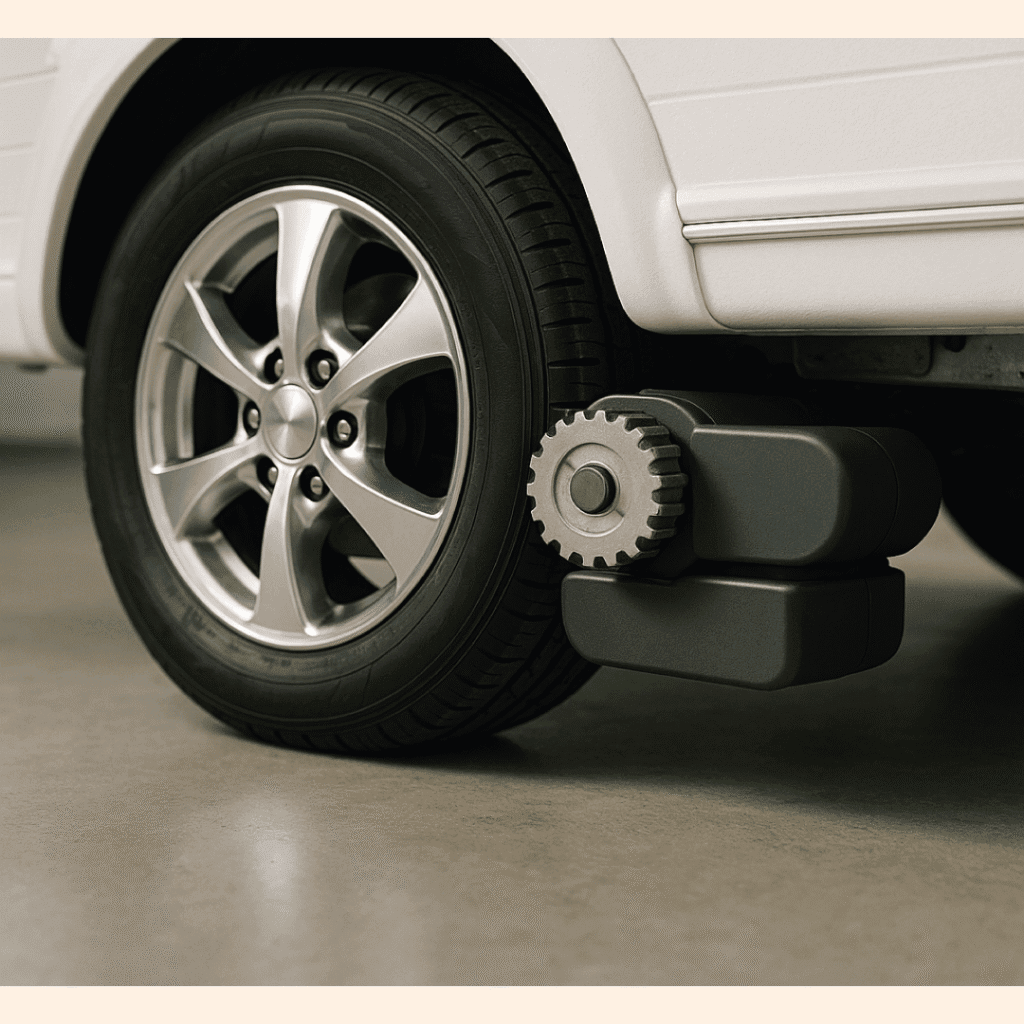
A mover is a 12V electric system that lets you move your caravan with millimeter precision using a remote control in tight spaces, on ramps, and in situations requiring delicate maneuvering. Via motorized rollers that press against the tire, it applies forward-backward, left-right, and on-the-spot turning commands in a controlled way. Single-axle caravans typically use two motors, while twin-axle caravans use four motors (AWD/Quad). Modern movers offer features like smooth start/stop, automatic roller engagement, slope compensation, and precise joystick/button control. When deciding, you need to consider the caravan’s actual laden weight, the slope of your parking area, your battery/cable infrastructure, and the service network together.
Mover Types
- Manually engaged: You press the roller against the tire with a lever/jack. Simple, lightweight, and relatively cost-effective. Example: AL-KO S21 (Ranger), Truma Smart M.
- Automatically engaged: Electric engagement at the push of a button; more consistent tire contact and comfort. Example: Truma Mover XT, Enduro EM305, Reich Easydriver Active/Pro.
- Chassis-integrated (premium): Systems like the AL-KO Mammut sit within the chassis rail, preserving ground clearance and reducing the risk of snagging on terrain obstacles.
- 4-motor (AWD/Quad): Provides maximum grip and directional control on twin-axle, heavy caravans; weight and cost increase.
Quick Selection: Which Mover for Which Scenario?
- <1,500 kg single axle, flat/firm ground: Manual/semi-automatic systems (AL-KO S21, Truma Smart M) are practical and economical.
- 1,500-2,000 kg single axle, tight spaces and frequent parking: Automatic-engagement comfort (Enduro EM305 or Reich Easydriver Active 2.3) makes a noticeable difference.
- 2,000-2,300 kg single axle, frequent ramps: A premium system with strong, efficient fine control (Truma Mover XT) is preferred.
- 2.3-2.8 t twin axle: Twin/quad configurations like the Reich Easydriver 2.8, or higher-tier 4-motor packages, for easier starts and steering.
- Low ground clearance, high obstacle risk: A chassis-integrated system (AL-KO Mammut) reduces scraping/snagging risks.
Technical Requirements and Real-World Usage Values
Movers run on 12V DC. On flat, even ground they typically draw 20-30A; during demanding moments like a curb ramp, a slope, or surface roughness, short-term peak currents of 80-140A can occur. Manufacturers usually give climbing figures for the caravan’s fully laden weight. It’s natural for the same model to reach higher gradient figures at a lighter load. For this reason, weighing your caravan fully loaded, measuring the slope of your parking area, and keeping your tire pressures at the correct level before choosing a mover noticeably improves selection accuracy.
Battery and wiring: An 85-100Ah or larger leisure battery is a practical minimum. LiFePO₄ batteries, thanks to low internal resistance and high discharge capability, reduce voltage sag during maneuvers; gel/AGM batteries also perform adequately when they have the correct capacity and are in healthy condition. A short run, 25-35mm² cross-section cable, and an ANL fuse near the battery (rated for peak current) form the backbone of the system. Preparing cable lugs with quality crimping against corrosion risk, and sealing connection points against water splashes, ensures long service life.
How to Use a Mover? (Step-by-Step)
- Secure the caravan: chocks, corner steadies, and a check of the surroundings.
- Check tires/wheels: pressure, tread gaps, and clean off any stones/debris.
- Engage the roller against the tire: with the manual lever or the automatic button.
- Release the handbrake, activate the remote, and move forward in micro-steps.
- As soon as you reach the target, apply the handbrake; immediately retract the roller.
- Turn off the remote; do a final check with chocks and corner steadies.
Tip: Don’t leave the roller pressed against the tire while parked; prolonged pressure can cause flattening of the rubber. Don’t pressure-wash it; silicone spray is suitable for the rails, while oily/tar-based sprays attract dust. Protecting the remote against drops and water, and making sure all users know the emergency-stop procedure, increases safety.
2026 Price Ranges (Summary Notes)
Although this varies with exchange rates and promotions, entry-level manual/semi-automatic solutions are budget-friendly; mid-range automatic-engagement systems offer a comfort balance; the premium segment (e.g., Truma Mover XT) stands out for precision and efficiency. For twin-axle, heavy caravans, twin/quad (4-motor) configurations or chassis-integrated premium options (AL-KO Mammut) are preferred. Before buying, compare authorized installation and warranty terms, free-installation promotions, and stock availability.
Brand and Model Comparison (Table)
| Model | Axle | Engagement | Max. Weight* | Gradient (typical)** | Unit Weight | Warranty |
|---|---|---|---|---|---|---|
| Truma Mover XT | Single | Automatic | ~2,300 kg | 20-25% | ~28 kg | 2+ years by country |
| Reich Easydriver Active 2.3 | Single | Manual | 2,300 kg | 12-20% (load-dependent) | ~35 kg | Up to 5 years with program |
| Reich Easydriver 2.8 (Twin) | Twin | Various | 2,800 kg | 10-12% @2.8t | – | Up to 5 years |
| Enduro EM305 | Single | Automatic | 2,000 kg | 12-18% | – | 2+ years by retailer |
| AL-KO S21 (Ranger) | Single | Manual | – | 10-15% | – | 2 years |
| AL-KO Mammut M20 | Single / Twin | Automatic (chassis-integrated) | ~2,250 kg moving | 25-28% | ~32 kg | 2+ years |
| Powrtouch Evolution | Single (AWD option) | Manual/Auto | 2,800 kg | 20-25% | ~30-35 kg | 5-year “no-quibble” |
* Manufacturer’s stated figure; may vary with axle layout and actual load. ** Gradient may vary depending on test conditions and tire/surface condition.
Installation, Warranty, and Maintenance
Installation: While DIY is possible, authorized installation is recommended to preserve warranty terms and to use the correct chassis brackets. Check your chassis type (AL-KO, etc.); place parts that could affect ground clearance within the chassis or in protected positions wherever possible. Keeping cable runs short, using a mechanical protective spiral/conduit along the chassis, and sealing pass-through points with grommets/rubber plugs brings long-term reliability.
Warranty: Brands offer warranty periods that vary by country/importer. A broad service network and easy parts access are decisive factors in real-world user satisfaction. It’s good practice to keep photographic records during installation for situations like faulty wiring, an improper fuse, or water damage that could affect warranty coverage.
Maintenance: Apply a silicone-based spray to the rails and mechanism at regular intervals; oily products can attract dust/sand and increase friction. Check electrical connections against corrosion; if rust forms at chassis connection points, refresh with sandpaper and a protective spray. Make sure all users know the remote, emergency-stop (E-stop), and manual open/close procedures.
Troubleshooting and Tips
- Low performance/sudden stopping: Measure battery voltage under load; check cable lugs, chassis grounding, and the fuse.
- Slipping or jerky movement: Bring tire pressure to the recommended value; clear dirt/mud from the roller-tire contact area.
- Remote losing connection: Replace the batteries; review the antenna position and receiver connections; check for strong RF interference sources nearby.
- Scraping/hitting the ground: Consider integrated solutions (Mammut) or protective plates for low-chassis vehicles.
Related Campexpert Guides (Internal Links)
- Caravan Battery Types: Gel, AGM, Li-ion, LiFePO₄ — choose the right battery for your mover.
- The Caravan Electrical Bay — good practices for cable gauges and fuse placement.
- Caravan Registration & Insurance (2026) — plan the official processes after installation.
- Caravan Conversion Tax Calculator — supports budget planning.
Frequently Asked Questions
Does a mover drain the battery quickly? Typical maneuvers last 2-5 minutes and total consumption is on the order of a few amp-hours. Weak batteries may sag in voltage at start-up and trigger a protective cutout; this is not a fault but an indicator of battery health.
Which tire type works better? While very aggressive tread patterns sometimes increase grip, they can also increase vibration; a balanced road tire at the recommended pressure gives smoother movement in most cases.
What should be done during long periods of non-use? Disengage the roller from the tire, remove or switch off the remote’s batteries; check electrical connections left outdoors at the start of the season.
Conclusion: How to Choose the Right Mover?
The choice can be reduced to a simple formula: actual laden weight + gradient needs + frequency of use + battery/cable infrastructure. For lighter caravans, manual/semi-automatic solutions are satisfying, while for users with frequent ramps and tight spaces, automatic engagement and premium precision provide noticeable comfort. For heavy, twin-axle caravans, twin/quad configurations or chassis-integrated solutions create a traction and ground-clearance advantage. As a final step, verifying authorized installation and the warranty network is the key to years of trouble-free use.