An inverter is what converts the 12/24 V DC energy stored in your caravan’s batteries into the 220–240 V AC that ordinary plug-in devices need — laptop chargers, microwaves, hair dryers. Instead of asking “which inverter is the most powerful,” this guide asks the more useful question: “given the devices I’ll actually run, which capacity and brand makes sense?” That’s because the most common mistake is picking a brand first and checking the actual need second.
Start With a Simple Calculation: How Many Watts Do You Need?
A laptop charger typically draws 65–90 W, a small blender 300–400 W, a hair dryer 800–1200 W, a coffee maker 800–1000 W, and a microwave 1000–1500 W. The real trap here is confusing “continuous power” with “peak/surge power”: compressor or motor-driven appliances (a mini-fridge, a blender, a hair dryer) draw 2–3 times their rated power for an instant at startup. Saying “a 1000 W inverter is enough” for a 1000 W appliance is often wrong — you need an inverter that can absorb that appliance’s 2000–2500 W startup surge. That’s why it matters to check both the “continuous W” and “peak/surge W” figures in a brand’s spec sheet; relying only on the VA (apparent power) number can be misleading, since the real continuous wattage can be lower depending on ambient temperature.
Why Pure Sine, Not Modified Sine?
Modified sine inverters are cheaper, but their output waveform is a stepped approximation of a sine wave rather than the real thing. On compressor-driven loads (fridges, air conditioners) that waveform causes extra heating and noise in the motor windings; on sensitive electronics (laptop charging circuits, some TVs) it can cause incompatibility or premature failure. That’s why pure sine inverters are the near-universal choice in caravans in practice — all four brands below output pure sine, so what actually separates them is feature set and integration quality.
Brands: Who Fits Which User?
Victron (Netherlands) — For Remote Monitoring and Eco Mode
Victron’s Phoenix VE.Direct 12/1200 sits in the 1200 VA class, compact with low no-load consumption, and can be switched on/off and monitored remotely via its VE.Direct port. The Inverter Smart 12/2000 adds Bluetooth configuration, an Eco mode (automatically cuts consumption under light loads), and dynamic low-voltage cutoff. The real reason to pick Victron is that if you’re already running a Victron MPPT or battery monitor, you can view your entire system from a single app — an integration that’s usually unavailable in a mixed-brand setup.
Renogy (USA) — For Anyone Who Needs UPS/Automatic Transfer
Renogy’s 2000 W model comes, in some packages, with UPS/automatic transfer functionality: when a grid or generator connection appears, the load switches to that source automatically with no interruption. That’s a genuine convenience if your camping style involves plugging into and unplugging from shore power at winter campsites — on the Victron side, an equivalent function usually requires a separate device like a Filax. The 1000 W model is simpler but does include Eco (power-saving) mode.
Epever (China) — For Anyone Moving to a 24 V System
Epever’s IPower series has a notable detail: its 2000 W class model ships with a 24 V input instead of 12 V (21.6–32 V range) and claims up to 95% efficiency. The practical implication is this: drawing the same power at 24 V instead of 12 V halves the DC current, which means thinner cable and less heat loss. If you’re already planning to move to 24 V in your caravan, or expect sustained high-power use (2000 W+), Epever’s 24 V option is a real technical edge over the mostly-12 V offerings from the other brands here.
Mexxsun (Turkey) — For Domestic Service and Bypass Charging
Mexxsun’s MEXTS/MEXTC series includes a REMOTE connector and 5V/2.1A USB output on the front panel, plus AC-IN and BY-PASS CHARGE inputs on the back — pointing to UPS-style logic that can both charge the battery and feed the load from shore power when it’s available. Being a Turkish-made brand means you can reach service directly in case of a fault, without waiting on an overseas distributor — that’s the real practical difference compared with imported brands.
Technical Comparison Table
| Brand / Model Class | System | Continuous Power | Peak (Surge) | Standout Feature |
|---|---|---|---|---|
| Victron Phoenix VE.Direct 12/1200 | 12 V | ~1200 VA class | — | VE.Direct remote monitoring, low no-load draw |
| Victron Inverter Smart 12/2000 | 12 V | ~2000 VA class | High | Bluetooth, Eco mode, dynamic low-voltage cutoff |
| Renogy 12 V 1000 W Pure Sine | 12 V | 1000 W | 2000 W | Eco mode, optional remote control |
| Renogy 12 V 2000 W (UPS) | 12 V | 2000 W | 4000 W | UPS/auto transfer, Bluetooth |
| Epever IPower 12 V 1000 | 12 V | 800 W (1000 W for 15 min) | 1600 W | THD ≤ 3%, low no-load current |
| Epever IPower 24 V 2000 | 24 V | 1600 W (2000 W for 15 min) | 3200 W | Up to 95% efficiency, 24 V input advantage |
| Mexxsun 12 V 1000 W class | 12 V | ~1000 W | — | AC-IN, BY-PASS CHARGE, REMOTE, 5V/2.1A USB |
| Mexxsun 12 V 2000 W class | 12 V | ~2000 W | — | Same UPS/Bypass logic, remote panel |
Quick Recommendations by Use Case
If you only run low-to-moderate loads — laptop, phone charging, LED TV — a 1000–1200 W class unit is enough (Victron Phoenix 12/1200, Renogy 1000, Epever IP1000-12, or the Mexxsun 1000 class). If you’ll run short-burst, high-draw appliances like a coffee maker, microwave, or hair dryer, step up to a 1500–2000 W class, and make sure to use thick DC cable and a short run at 12 V (Renogy 2000 UPS, Victron Inverter Smart 12/2000, or the Mexxsun 2000 class). If you’re expecting sustained high loads — say, testing a small air conditioner — moving to a 24 V system and considering Epever’s 24 V IP2000-22 is more practical than staying at 12 V and wrestling with oversized cable and fuses.
Installation and Safety: What Gets Overlooked
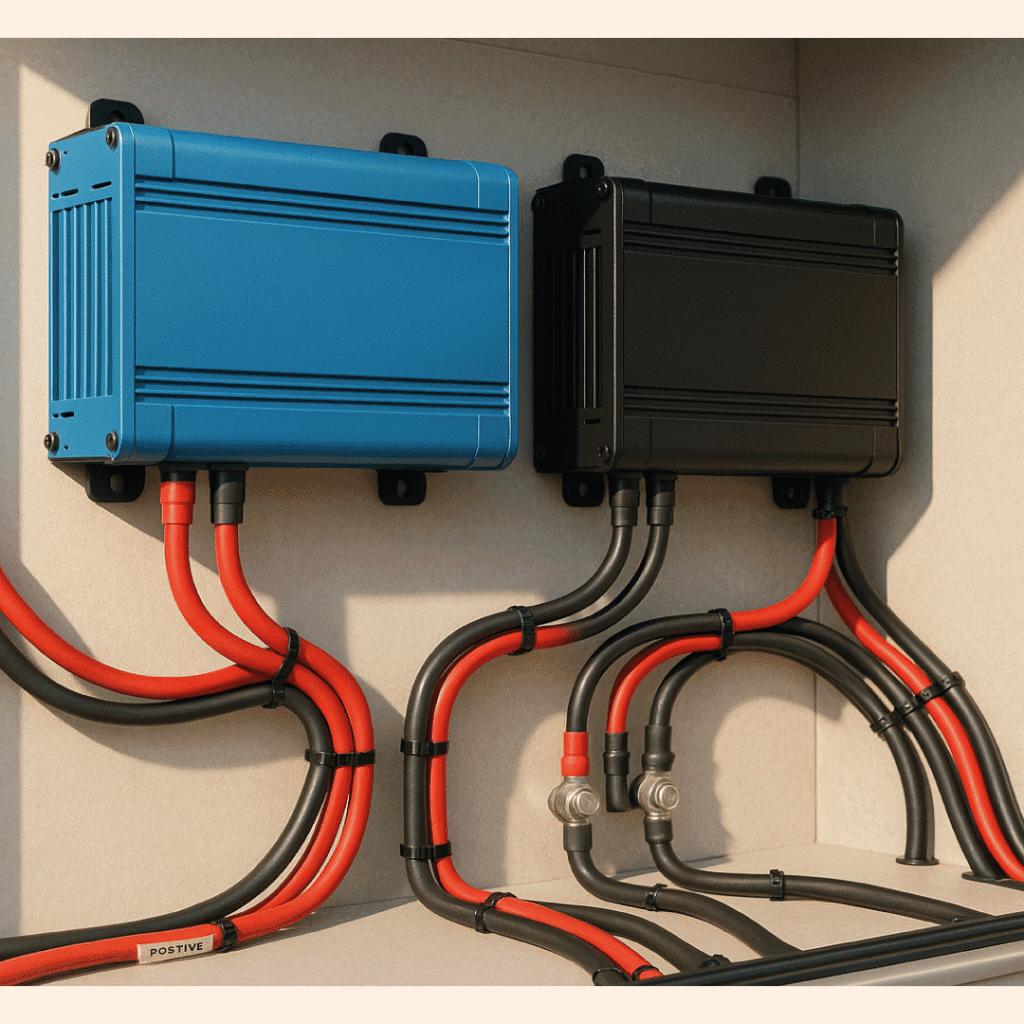
Drawing 2000 W from a 12 V system means roughly 160–180 A of DC current — an unusually high figure by automotive-electrical standards, and it demands a short cable run, at least 50 mm² cable cross-section, an ANL- or Mega-type fuse mounted close to the battery, and a solid chassis ground. Cramming the inverter into a closed cabinet is another common mistake: inverters heat up under load, and stepping outside the manufacturer’s stated operating temperature range triggers thermal throttling or a full protective shutdown. If you’re switching between grid/generator power and the inverter, a unit without automatic transfer/UPS means doing that switch manually and accepting a brief interruption — this is where Renogy’s UPS-equipped model or Mexxsun’s AC-IN/Bypass input makes life easier.
Frequently Asked Questions
Can a modified sine inverter be used in a caravan?
Technically it works, but it can cause heating and noise in compressor/motor-driven appliances and incompatibility with sensitive electronics. In practice, pure sine inverters are the recommended choice for caravans.
Is it safe to use a 2000 W inverter on a 12 V system?
It’s possible, but the high DC current makes cable sizing, fuse selection, and thermal management more demanding. At this power level, a 24 V system is both safer and more practical.
How should I interpret the difference between “VA” and “W”?
VA is apparent power; the real continuous wattage can be lower depending on ambient temperature and the inverter’s efficiency. When deciding, it’s more reliable to go by the continuous W figure in the spec sheet.
Does the Mexxsun MEXTS/MEXTC series support automatic grid transfer (UPS)?
The AC-IN and BY-PASS CHARGE inputs on the unit indicate that when shore power is available, the battery can be charged while the load is fed from the grid — pointing to basic UPS/Bypass logic.
Disclaimer: This content uses manufacturer and retailer technical data; prices and stock availability may change over time. Before purchasing or installing, review each model’s current official documentation and have the installation done by a qualified caravan electrical technician. Product and brand names belong to their respective owners.