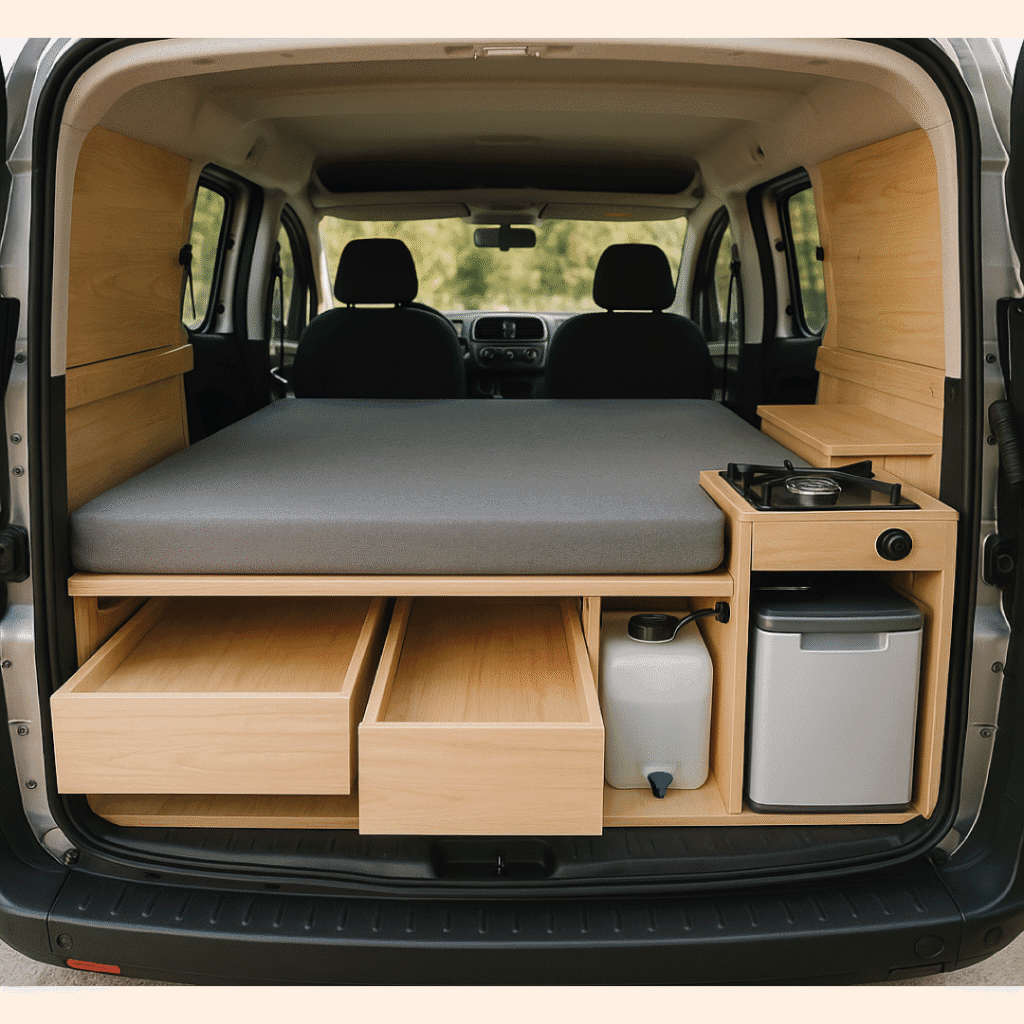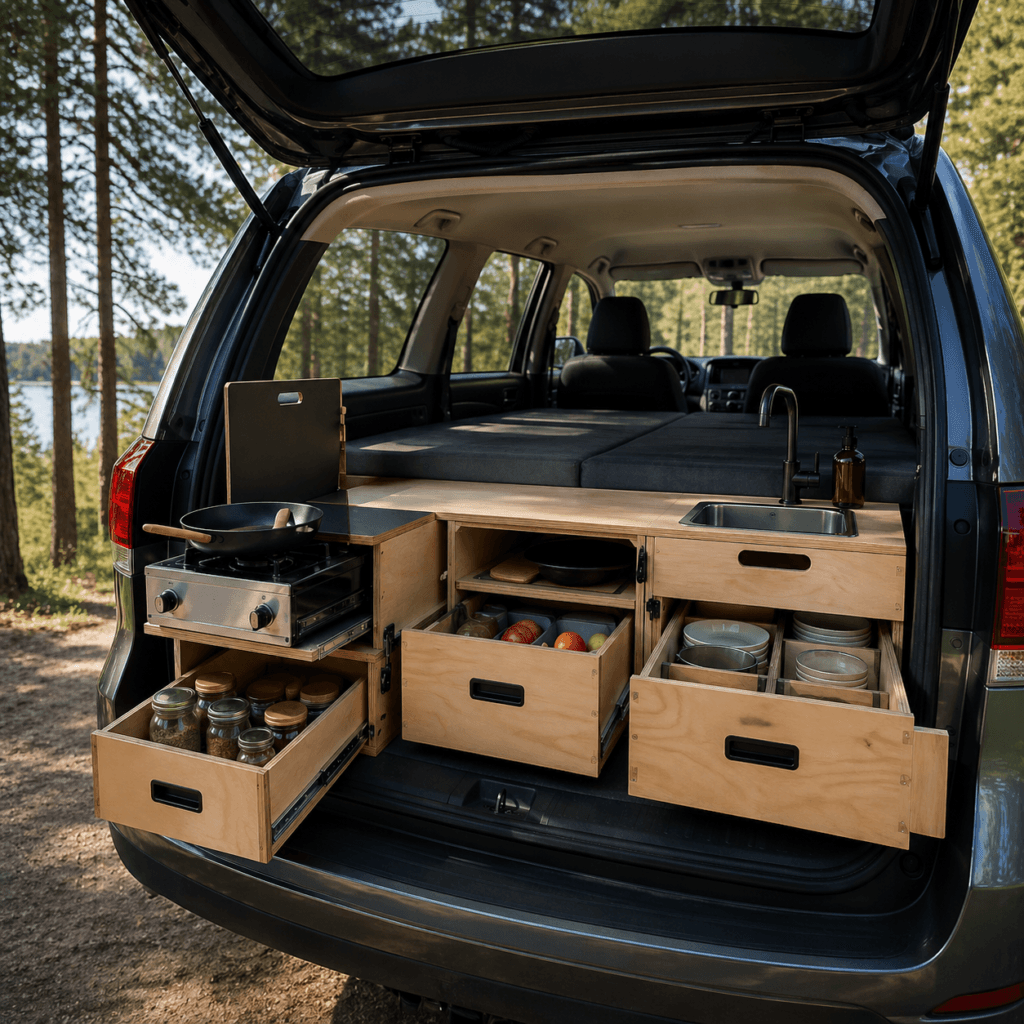
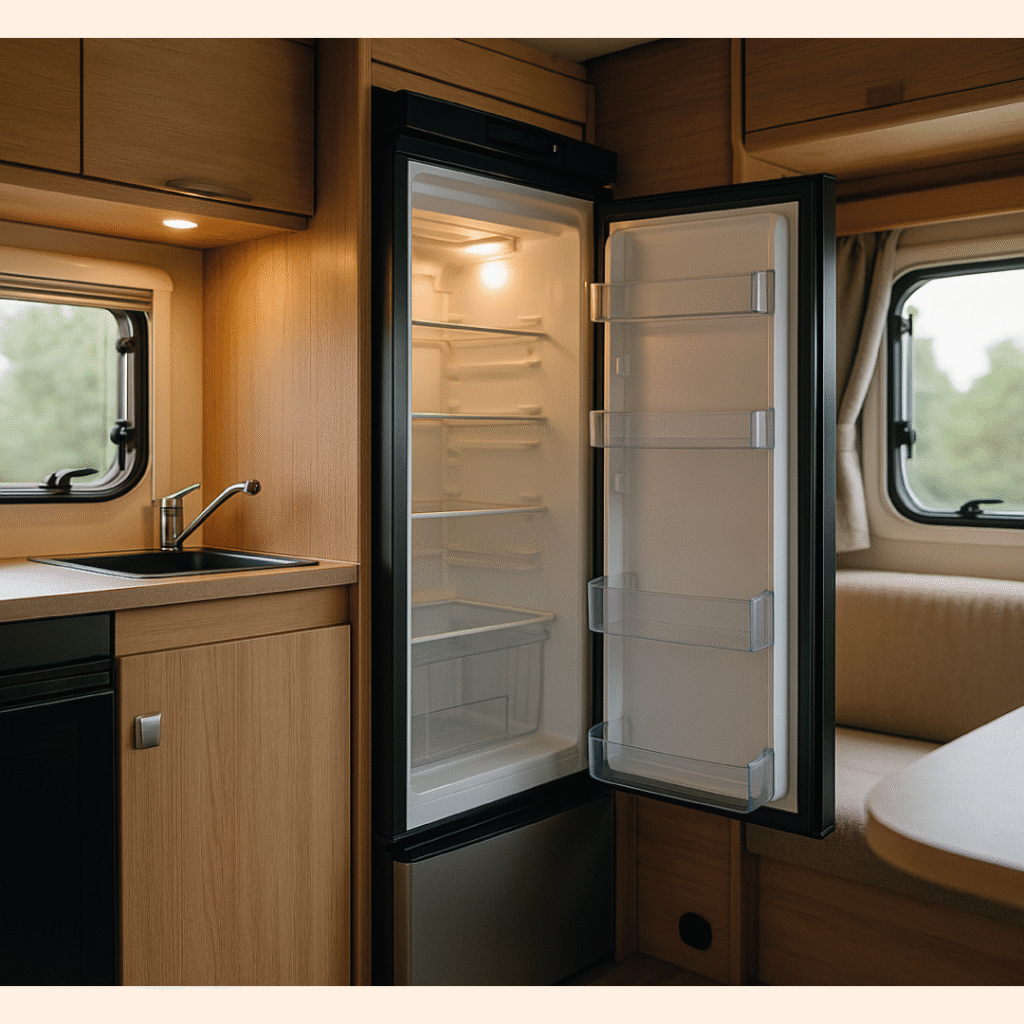
Cooling directly shapes comfort in caravan life. So which is smarter for a caravan: a 12V (DC) fridge or a 220V (AC) household-style fridge? In this guide we explain the pros and cons, consumption calculations, required equipment, and hazard/safety topics with examples everyone can follow.
Quick Comparison
| Topic | 12V (DC) | 220V (AC + inverter) |
|---|---|---|
| Energy efficiency | High (no inverter loss) | Medium (inverter efficiency/idle consumption loss) |
| Installation | Simple (direct DC) | More complex (inverter, wiring, ventilation) |
| Service/Parts | May require a specialist | Widespread service/easy parts |
| Off-grid (solar/battery) compatibility | Very high | Medium-low (consumption can be high) |
| Upfront cost | Unit can be expensive | Unit is affordable, but inverter cost is added |
12V Refrigerator (DC Compressor)
Advantages
- Runs directly from a battery/solar setup, no inverter needed.
- Generally lower daily consumption (no inverter loss).
- The best-suited structure for off-grid (extended camping) use.
Disadvantages
- Quality models can be expensive.
- Converted/improper DC solutions can cause failures and excess consumption.
- Not every repair shop is familiar with the DC compressor/electronic board.
Tip: Choose an “original” 12V DC compressor fridge. “Converted” solutions where a household fridge has been adapted to 12V are often inefficient.
220V Refrigerator (AC, with Inverter)
Advantages
- Household-level capacity/comfort; good price/service access.
- Works fine directly off 220V at powered campsites.
Disadvantages
- Inverter loss and idle consumption increase electricity needs.
- High momentary currents can strain the battery bank.
- Installation is complex: adequately sized cable, fuses, and ventilation are essential.
Note: The inverter must be pure sine wave; an inadequate/low-quality inverter can damage both the fridge and other devices.
Consumption Calculation: Simple Formulas and Examples
A practical way to understand daily consumption: Daily Wh = Average Power (W) × 24 hours × Duty Cycle. For DC fridges, the duty cycle (the compressor’s running percentage) varies with ambient temperature and usage habits (e.g. 30–50%).
- Example, 12V DC: Average 35 W, 40% duty cycle → 35×24×0.40 ≈ 336 Wh/day (~28 Ah/day @12V).
- Example, 220V AC + inverter: Fridge avg. 45 W, 40% duty cycle → 45×24×0.40 = 432 Wh/day. Add inverter efficiency/idle consumption (~10–25%) → ≈ 480–540 Wh/day.
Battery sizing guide: Target number of days × daily Wh ÷ (battery system voltage × usable capacity ratio). Usable capacity can be assumed at ~80% for LiFePO4 and ~50% for AGM/Gel.
| Scenario | Daily Consumption | Minimum Battery for 2 Days Off-Grid |
|---|---|---|
| 12V DC example | ~336 Wh | LiFePO4 ~70–90 Ah @12V (80% usable) |
| 220V AC + inverter | ~500 Wh | LiFePO4 ~110–130 Ah @12V (80% usable) |
Solar guide (rough estimate): Assuming an average of 4–5 “peak sun hours” per day in Turkey during summer, Panel Wattage × 4–5 ≈ Wh/day. E.g. a 200W panel can produce ≈ 800–1000 Wh/day (watch out for weather/shade/heat effects).
Note: These calculations are examples. Actual consumption varies with fridge volume, insulation, ambient temperature, how often it’s opened, and how full it’s kept.
Required Equipment (Suggested Ranges)
12V DC System
- Original DC compressor fridge
- Battery: 100–200 Ah LiFePO4 (depending on use)
- Solar: 150–300 W panel + MPPT charge controller
- Wiring: Properly sized cable + fuse on every branch + main fuse
- Heat/vent: Air circulation behind the fridge
220V AC System
- Household-style fridge (good energy-class models)
- Inverter: Pure sine wave, continuous power must cover the fridge’s startup surge (typically 600–1000 W recommended)
- Battery: 150–300 Ah LiFePO4 (depending on use)
- Solar: 200–400 W panel + MPPT
- Ventilation: Good airflow for the inverter, choose a model with low idle consumption
Hazards and Safety
- Overcurrent/thin cable: Overheating and fire risk. Proper cable gauge and fuses are essential.
- Low-quality inverter: Risk of device damage and electric shock. Use a certified, pure sine wave unit.
- Over-discharge: Shortens battery life. Use a BMS with alarms and low-voltage protection.
- Insufficient ventilation: Inverter/fridge overheats, efficiency drops, failures increase.
- Improper conversion: An improper DC conversion of a household fridge ruins efficiency and creates failure/fire risk.
Warning: Have the electrical installation done by competent professionals. Fuses, breakers, grounding, and cable gauges are of critical importance.
Which One for Which Situation?
- Long off-grid camping / solar-heavy use: Original 12V DC fridge.
- Powered campsites / service access priority: 220V household model + quality inverter.
- Minimum consumption and simplicity: 12V DC.
- Larger capacity/more affordable unit price: 220V AC.
Frequently Asked Questions (FAQ)
Does a 12V fridge really use less electricity?
Yes, because there’s no inverter loss. However, this applies to original 12V DC compressor fridges. Improper conversions can consume more.
Can I use a 220V household fridge in a caravan?
Yes. It’s possible with a pure sine wave inverter and adequate battery/fuses/cabling. Choose an inverter with low idle consumption.
How many Ah of battery do I need?
Depends on your daily consumption and how many days you’ll be off-grid. For example, with ~350 Wh/day consumption, LiFePO4 ~70–90 Ah may be enough for 2 days. Add a safety margin.
How many watts of solar panel do you recommend?
For typical fridge-focused use, a 150–300 W panel is a good starting point. It can be increased based on season/shade/heat.
How many watts should the inverter be?
Generally a 600–1000 W range is preferred to cover the fridge’s startup surge. Check the manufacturer’s data.
How do I reduce fire risk?
Correct cable gauge, a fuse on every circuit, quality equipment, good ventilation, and expert installation. Don’t skip low-voltage/overcurrent protections.
Quick Start: Calculate Your Own System
Enter your daily consumption and instantly see the recommended battery and panel power.
Disclaimer: This guide is for general informational purposes. Electrical wiring work is risky; it must always be checked and installed by competent professionals.