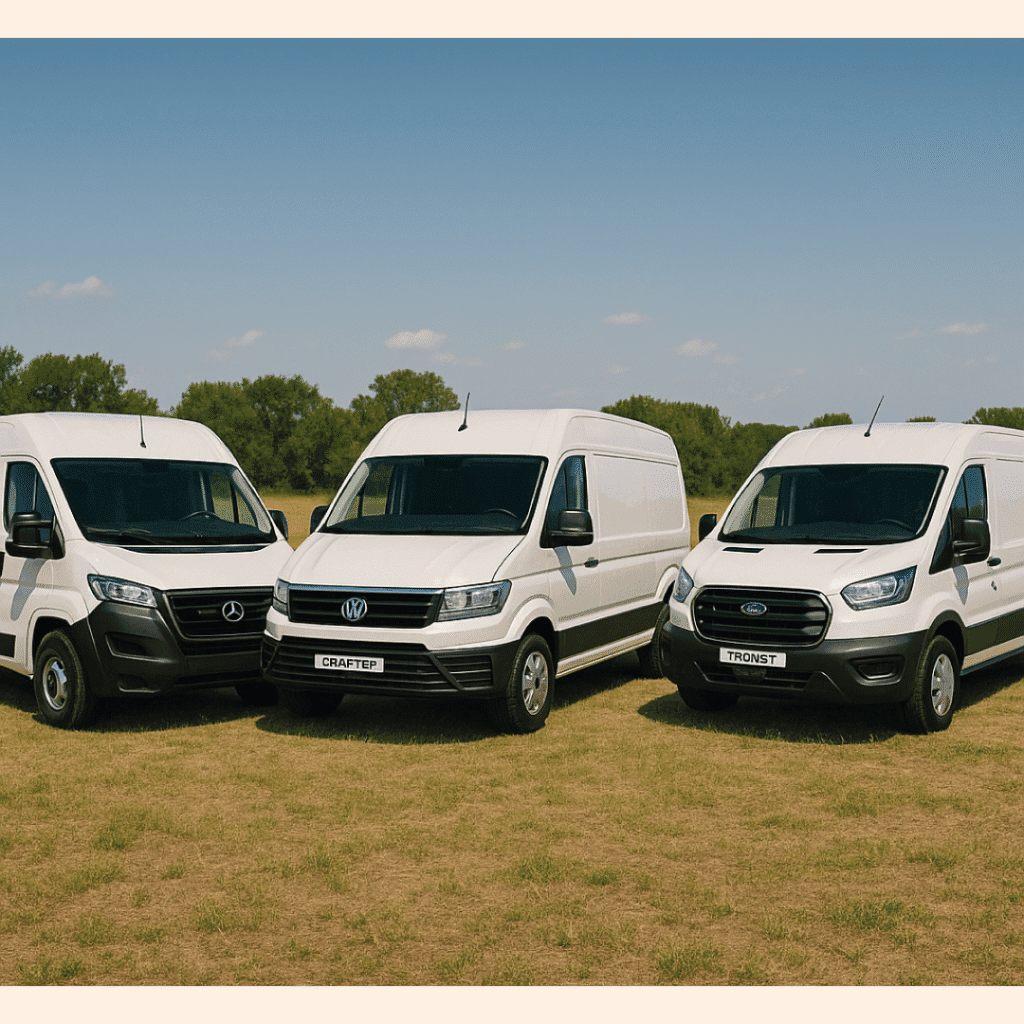
The most critical decision you’ll make in a campervan build is which vehicle to base it on. The right base vehicle determines everything — from interior width and bed layout to driving comfort, fuel consumption, maintenance cost, and resale value. In this mega guide, we take a close, practical look at the four most popular choices for camper conversions under current conditions in Turkey: the Fiat Ducato, Mercedes Sprinter, Volkswagen Crafter, and Ford Transit.
Our goal is to answer every question you might have when deciding between these four models, with as objective and field-based a view as possible.
1. Key Criteria That Affect Vehicle Choice for Camper Conversion
Not every vehicle suits every user. Let’s first get clear on which criteria actually matter when choosing.
1.1 Interior Width
Interior width is the single most critical measurement for whether you can fit a transverse (side-to-side) bed and how open the interior feels. For a bed of 180 cm or more, you generally need at least 185–190 cm of real interior width.
- Fiat Ducato: roughly 187–202 cm → the best option for a transverse bed.
- VW Crafter: roughly 183–198 cm → a side bed is possible with careful design.
- Mercedes Sprinter: 178–182 cm → a side bed is borderline; a lengthwise bed is usually preferred.
- Ford Transit: 175–178 cm → generally requires a lengthwise bed.
1.2 Interior Height
Being able to stand up dramatically improves quality of life in a camper. The H2 and H3 body codes are the deciding factor here.
- Ducato: 190–210 cm (H2/H3) → comfortable standing headroom.
- Sprinter: 178–207 cm → varies by model and roof height.
- Crafter: 184–204 cm → roomy headroom in the modern body styles.
- Transit: 170–200 cm → borderline in some H2 models.
1.3 Chassis Geometry and Body Structure
- Ducato: the body closest to a rectangular box, with flat side walls and ceiling; friendly for carpenters building cabinets, bathroom, and kitchen modules.
- Sprinter: slightly curved sides and an arched roof; solid, but requires a bit more careful measuring when fitting furniture.
- Crafter: similar to the Sprinter but with more modern interior lines; insulation and interior panel work need extra care.
- Transit: a more pronounced interior roof slope; cabinets may need extra work to sit flush against the wall.
1.4 Engine and Drivetrain
A vehicle’s weight increases significantly after a camper conversion, which makes torque and drivetrain choice more important.
- Ducato: 2.3 Multijet (130–180 HP), generally front-wheel drive (FWD) → more interior space plus economical consumption.
- Sprinter: 2.1 CDI and 3.0 V6 options, mostly rear-wheel drive (RWD), with optional 4×4 → leads the pack for load capacity and off-road performance.
- Crafter: 2.0 TDI, with FWD and AWD options → comes with modern driver-assist systems.
- Transit: 2.0 EcoBlue, FWD and AWD in some trims → a balanced, economical character.
1.5 Service Network, Parts Availability, and Cost
When traveling with a camper, it’s not just fuel that hurts — maintenance and repair costs matter just as much.
- Sprinter: a strong service network across nearly all of Turkey; parts are easy to find, but also the most expensive.
- Ducato: strong service and parts availability, at a noticeably lower cost than the Sprinter.
- Transit: the most economical brand in terms of spare-parts availability and pricing.
- Crafter: solid VW build quality, but commercial service density and parts lead times can be a disadvantage in some regions.
1.6 Fuel Consumption (Loaded as a Camper)
Wind resistance, weight, and speed all affect consumption heavily, but typical ranges look like this:
- Ducato: 7.5–8.5 L/100 km (at reasonable speed and normal load).
- Sprinter: 8.5–10.5 L/100 km (especially in long, high-roof, and 4×4 variants).
- Crafter: 8–9.5 L/100 km.
- Transit: 8–9.5 L/100 km.
1.7 Resale Market and Depreciation
The answer to “will I get stuck with this if I want to sell it later?”:
- Sprinter: sells the fastest and depreciates the slowest.
- Ducato: has a strong resale market thanks to demand from both campervan builders and haulage operators.
- Transit: easy to sell thanks to a broad commercial market, though at a lower price scale.
- Crafter: more niche; buyers are specific, and it can take somewhat longer to sell than the others.
2. Price and Availability (Early-2025 Reference Prices)
Currency swings and rising new-vehicle prices have significantly affected the base-vehicle market. As a rough guide, for mid-mileage vehicles (100,000–250,000 km) as of early 2025, the picture looks roughly like this:
- Fiat Ducato L2H2 / L3H2: roughly 580,000–1,400,000 TL.
- Mercedes Sprinter (long chassis, high roof): roughly 700,000–1,900,000 TL.
- VW Crafter: roughly 800,000–2,100,000 TL.
- Ford Transit (high roof, long chassis): roughly 450,000–1,200,000 TL.
These figures vary a lot by trim, mileage, and history — the point here is simply to show the relative price gap between the four.
Note: the prices above reflect early-2025 listings. Turkish lira vehicle prices move quickly with currency and inflation swings, so treat this only as a relative comparison between the four models, not a current quote. For live listings, check sahibinden.com or arabam.com. Last checked: 18 July 2026.
3. Mega Technical Comparison Table (Summary)
The table below lets you compare, at a glance, the technical and practical traits that matter most for camper conversion across all four vehicles.
| Feature | Fiat Ducato | Mercedes Sprinter | VW Crafter | Ford Transit |
|---|---|---|---|---|
| Interior width | 187–202 cm (class leader) | 178–182 cm | 183–198 cm | 175–178 cm |
| Interior height (H2/H3) | 190–210 cm | 178–207 cm | 184–204 cm | 170–200 cm |
| Body shape | Near-square, flat sides | Long, slightly oval | Modern, slightly oval | More sloped roof |
| Drivetrain | FWD | RWD / AWD | FWD / AWD | FWD / AWD |
| Typical engine | 2.3 Multijet | 2.1 CDI / 3.0 | 2.0 TDI | 2.0 EcoBlue |
| Fuel consumption (loaded as a camper) | 7.5–8.5 L | 8.5–10.5 L | 8–9.5 L | 8–9.5 L |
| Service network (Turkey) | Very broad | Broadest | Moderate | Very broad |
| Parts cost | Relatively affordable | High | High | Most affordable |
| AWD/4×4 option | None | Yes (very capable) | Yes | Yes |
| Transverse bed | Comfortably possible | Borderline / difficult | Possible (with the right design) | Usually difficult |
| Conversion difficulty | Low (carpenter-friendly) | Moderate | Moderate | Low / Moderate |
| Resale market | Strong | Strongest | Niche | Strong |
4. Fiat Ducato — The Body-Shape Standard of the Camper World
The Fiat Ducato serves as the base vehicle for most factory-built campervans in Europe. That’s not just about price — it comes down to having a body geometry that’s naturally well-suited to camper layouts.
4.1 Body and Interior Volume Advantages
- Near-square body: the roof and side walls are relatively flat, making it easy to design cabinets, bathroom, and kitchen modules like simple “cubes.”
- High interior width: one of the best vehicles for a transverse bed; 180–190 cm beds fit in relatively comfortably.
- Low loading threshold: easy to get in and out of, and since the vehicle isn’t 4×4, you get sufficient headroom without needing to raise the interior floor.
4.2 Engine, Transmission, and Driving Character
The most common engine, the 2.3 Multijet, offers a well-balanced character for camper use:
- Enough torque in the mid-rev range → satisfying pulling power on long trips.
- More than adequate performance for campers who aren’t chasing high speed.
- Front-wheel drive gives safe, predictable handling on flat roads.
The downside: on high-altitude, long, steep climbs, it doesn’t feel as powerful as a Sprinter, and may require more frequent downshifting.
4.3 Known Chronic Issues
- EGR fouling: especially common with short-distance, frequent stop-start use.
- Turbo hose cracking: becomes more likely past a certain mileage; since it’s a commonly replaced part in camper conversions, most mechanics are familiar with it.
- Front suspension wear: can develop noise over time under a combination of heavy load and rough roads.
4.4 Maintenance and Parts Costs
Another reason the Ducato is popular among campervan owners is its relatively affordable maintenance cost. Compared with a Sprinter in the same class, it comes out cheaper on many line items:
- Timing belt kit prices are more reasonable.
- Injector and turbo prices are noticeably lower than Mercedes.
- Mechanics are relatively easy to find, and labor times tend to be shorter.
4.5 Effect on Camper Interior Design
Since the Ducato is almost a “rectangular box” from a furniture-building standpoint:
- Standardizing cabinet depths is very easy.
- You spend far less time working around designs like a transverse bed, a square shower cubicle, or flat ceiling cabinets.
- Insulation and interior lining panels need much less cutting and shaping compared with sloped ceilings.
4.6 Who Is It the Right Choice For?
- Anyone planning a family camper for 2–4 people.
- Those who want an open interior and generous storage.
- Users who mostly stick to paved and lightly graded roads rather than rough terrain.
- Anyone who wants to keep both the upfront investment and ongoing maintenance costs in check.
In short: if you’re after the combination of the most interior volume, the easiest conversion, and reasonable cost, the Ducato deserves to be at the top of your list.
5. Mercedes Sprinter — Champion of Durability and Driving Comfort
The Mercedes Sprinter has become something of a durability icon in the panel-van world. Its 2.1 CDI engine and solid chassis in particular give campervan owners who cover long distances a great deal of confidence. Its 4×4 options also put it ahead of the competition for off-road and winter conditions.
5.1 Body and Interior Volume
The Sprinter is somewhat narrower than the Ducato, but its long-chassis options allow for very generous living spaces.
- Interior width: 178–182 cm → a transverse bed is borderline for most users; a lengthwise bed is usually preferred.
- Interior height: high-roof versions get close to 200 cm, with no trouble standing up.
- Chassis strength: built on a platform accustomed to years of heavy-load hauling, it inspires confidence even under a camper’s weight.
5.2 Engine, Drivetrain, and Driving Feel
The Sprinter’s biggest advantage is its rear-wheel drive (RWD) and optional 4×4 systems.
- It carries a heavy camper body much more comfortably uphill, on inclines, and on mountain roads.
- Traction on snowy or muddy ground is noticeably better than front-wheel-drive vehicles.
- The long-chassis-plus-RWD combination feels stable even at highway speeds.
The 2.1 CDI engine, when well maintained, is a unit that can run trouble-free to very high mileages. The 3.0 V6 is in a league of its own for those who want power and refinement, but it costs more.
5.3 Known Chronic Issues
- Injector leaks: frequently reported on older-generation Sprinters; can damage the cylinder head if not addressed in time.
- Steering box play: can appear at high mileage on vehicles used on heavily potholed roads.
- OM651 timing chain noise: tends to show up at very high mileage, usually the result of neglected maintenance.
5.4 Driving Comfort, Road Noise, and Safety
Compared with many vehicles in its class, the Sprinter offers:
- Less cabin noise,
- A more refined steering feel,
- Better braking and road-holding performance.
For campervan owners covering long distances — especially loaded and at higher speeds — this difference translates into real day-to-day comfort.
5.5 Who Is It the Right Choice For?
- Anyone planning to use the vehicle for many years at high mileage.
- Those heading for ambitious routes like off-road terrain, mountain roads, or winter camping (especially with 4×4).
- Anyone who wants high driving comfort and a strong sense of safety.
- Users who can tolerate somewhat higher maintenance and parts costs.
In short: if longevity, reliability, and a 4×4 option are critical for you, the Sprinter is usually the smartest — if also the most expensive — choice.
6. VW Crafter and Ford Transit — Balancing Modern Technology and Economy
6.1 VW Crafter
The Crafter stands out especially in its newer body styles for its modern electronic safety and driver-assist systems. Features like adaptive cruise control, lane-keeping assist, driver fatigue warnings, and advanced infotainment are a real plus for long-trip comfort.
- Pros: generous interior volume, modern driving technology, AWD option, quiet cabin.
- Cons: a more limited service network in Turkey, a DSG transmission that needs careful maintenance, and higher parts costs.
For tech-savvy users chasing a modern feel who live near major cities for servicing, the Crafter is a strong candidate.
6.2 Ford Transit
The Transit is arguably the “most economical base vehicle” under Turkish conditions in particular.
- Pros: a very broad service network, the most affordable parts pricing, a strong commercial user base, and reasonable fuel consumption.
- Cons: somewhat narrower interior width than its rivals, and an interior roof geometry that needs more adaptation for furniture building.
For budget-focused camper projects — especially for users who say “it doesn’t need to be luxurious, it just needs to work” — the Transit is more than enough of a platform.
7. Which Vehicle Suits Which Type of User?
Here’s a quick matching summary:
- A camper for two, mostly on paved roads, focused on interior space and comfort: the Fiat Ducato.
- Four-season use, off-road and winter camping, wanting high safety: the Mercedes Sprinter (especially 4×4).
- A tech enthusiast who wants adaptive cruise and modern safety features: the VW Crafter.
- “My budget is limited, but I want something solid and easy to find”: the Ford Transit.
In the next installment of this guide, we’ll go further — into a much more detailed matrix based on user scenarios and buying strategies for the Turkish market, and 20+ of the most frequently asked questions.