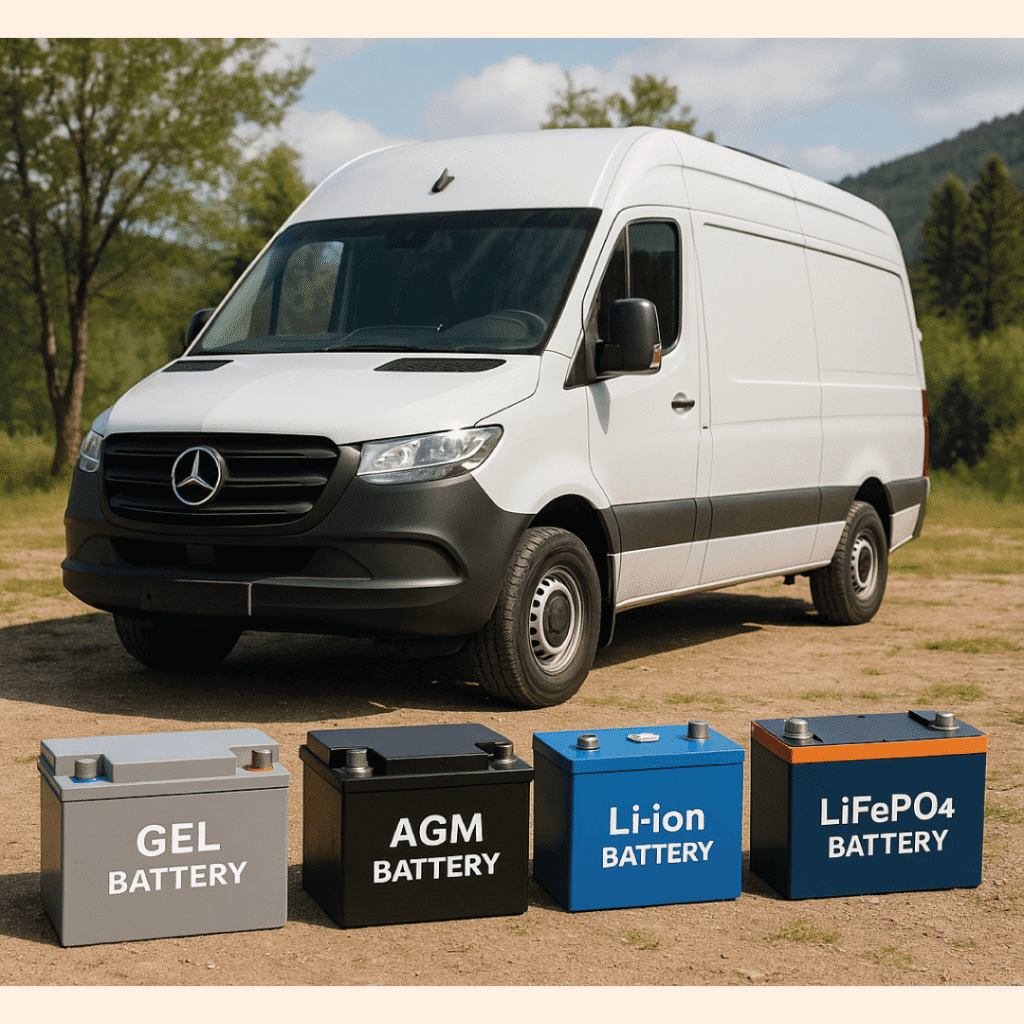
From lighting to the fridge, from the inverter to the heater, the right caravan battery is essential for everything. In this guide we explain battery types in plain language, along with their pros/cons and safety risks, and finish with step-by-step selection guidance based on your needs.
Important: “Lithium-ion” is a general family name. LiFePO₄ (LFP) is the safest and longest-lasting sub-chemistry of this family for caravan use. In other words, they’re not the same thing; LiFePO₄ is the specific, caravan-friendly type of Li-ion.
1) Basic Concepts
- Voltage (V): Mostly 12V (sometimes 24V) systems in caravans.
- Capacity (Ah): The amount of energy the battery can store. 100Ah ≈ ~1200 Wh theoretical energy on a 12V system.
- DOD (%): Depth of Discharge. 80% DOD means using 80% of the capacity.
- Cycle Life: Number of full charge↔discharge cycles. (e.g. 2000 cycles)
- C-Rate: Relates charge/discharge current to capacity. 1C = 100A for a 100Ah battery.
- BMS: (in Li-ion/LFP) The Battery Management System protects cells and provides balancing and safety.
2) Flooded (Lead-Acid) Batteries
The oldest and cheapest solution. The electrolyte is liquid.
Advantages
- Very good price/availability.
- Compatible with simple chargers.
Disadvantages
- Needs regular maintenance (topping up water); risk of spillage.
- Heavy and bulky; doesn’t tolerate deep discharge well.
Hazards
- Gas emission (H2) and risk of explosion/poisoning in enclosed spaces.
- Corrosion and equipment damage if it leaks.
3) Gel Batteries
Part of the lead-acid family; the electrolyte is gelled and sealed.
Advantages
- Maintenance-free, sealed.
- More resistant to deep discharge than flooded batteries.
Disadvantages
- More expensive; doesn’t like fast charging (needs special charge curves).
Hazards
- Wrong charge voltage rapidly shortens lifespan.
4) AGM Batteries
The electrolyte is absorbed into glass-fiber mats. Resistant to high current draw and vibration.
Advantages
- Maintenance-free, sealed.
- Tolerates fast charging better than gel.
- More resistant to high discharge currents (good for loads like inverters).
Disadvantages
- Priced higher than flooded/gel.
- Lifespan can shorten in hot environments.
Hazards
- Charging at the wrong voltage causes damage.
5) Lithium-Ion (Li-ion) – General Category
An umbrella term used in areas like phones/laptops/EVs; it has sub-chemistries like NMC, NCA, LCO, etc.
Advantages
- High energy density (lighter/more compact).
- Fast charging capability.
Disadvantages
- Not every sub-chemistry suits a caravan’s steady, long-duration power needs.
- Generally more expensive and more thermally sensitive.
Hazards
- Without a proper BMS/charger, the risk of overheating and fire increases.
6) Lithium Iron Phosphate (LiFePO₄) – Why Is It a Caravan Favorite?
LiFePO₄ is the iron-phosphate-cathode sub-chemistry of the Li-ion family. This is what’s most commonly meant by “lithium battery” in a caravan.
Advantages
- Very long life (approx. 2000-5000 cycles, depending on use conditions).
- Efficient capacity use with 80-90% DOD.
- Thermally stable, high safety level.
- Fast charge/discharge performance, lightweight.
Disadvantages
- More expensive than lead-acid derivatives.
- Requires a proper BMS and suitable charging infrastructure.
Hazards
- In low-quality packs the BMS can be inadequate; lifespan and safety are affected.
7) Summary Comparison Table
| Battery Type | Price | Cycle Life | Safety | Maintenance | Caravan Suitability |
|---|---|---|---|---|---|
| Flooded (Lead-Acid) | ⭐ | ⭐ | ⚠️ Low | Required | Low consumption, short stays |
| Gel | ⭐⭐ | ⭐⭐ | ✅ Medium | None | Medium consumption, longer camping |
| AGM | ⭐⭐ | ⭐⭐⭐ | ✅ Medium | None | High current needs |
| Li-ion (General) | ⭐⭐⭐ | ⭐⭐ | ⚠️ Medium | None | Depends on the caravan model |
| LiFePO₄ | ⭐⭐⭐⭐ | ⭐⭐⭐⭐ | ✅✅ Very High | None | Best overall choice |
8) Which Battery Should I Choose? (Step by Step)
Roughly work out your consumption: List lighting, fridge, fans, chargers and any high loads like a coffee machine/AC. (Typically ~1000-1500 Wh/day for light use, ~2000-3000 Wh for medium, 3000+ Wh for heavy use.)
Think about your camping duration: Gel/AGM can do the job for weekend getaways. LiFePO₄ stands out for long stays or four-season use.
Budget & weight: If you want a low upfront cost, Gel/AGM; for weight/lifespan advantages, LiFePO₄.
Sample quick matching:
- Light use 100-150Ah Gel/AGM + 150-250W PV
- Medium use 100-150Ah LiFePO₄ + 300-400W PV
- Heavy use 200-300Ah LiFePO₄ + 500-800W PV
(PV: total solar panel power; actual needs vary by devices and climate.)
Tip: On systems with an inverter (coffee machine, microwave, etc.), LiFePO₄’s high discharge current and voltage stability provide a big comfort advantage.
9) Charging & Installation Notes
- Solar (MPPT): Panel→MPPT→Battery. A voltage/current profile suited to the battery chemistry is essential.
- Vehicle alternator: Use a DC-DC charger on modern vehicles; don’t connect directly.
- Mains charging: Choose a multi-stage charger compatible with your battery chemistry.
- Fuses & cable: A properly rated fuse at the start of each line; cable sized for the current.
- Ventilation: Mandatory for flooded batteries. Gel/AGM are sealed but a cool, dry environment is still good.
- Temperature: Extreme heat shortens the lifespan of all batteries; LiFePO₄ may have charging restrictions in low temperatures (choose BMS models with low-temperature protection).
10) Frequently Asked Questions
Are Li-ion and LiFePO₄ the same thing?
No. Li-ion is a general family; LiFePO₄ is the safer sub-chemistry of this family, very well suited to caravan use.
AGM or LiFePO₄?
If budget/upfront cost is low, AGM can make sense. For long life, light weight and deep-discharge advantages, LiFePO₄ is superior.
How many Ah should I get?
Divide your daily consumption (Wh) by about 12; increase the resulting Ah figure by 20-30% for DOD and efficiency losses. (e.g. 1500 Wh ≈ 125Ah; ~150Ah is a good starting point for LiFePO₄.)
Can I use my old charger?
Chargers with a lead-acid profile may not be compatible with LiFePO₄. Compare against manufacturer specs; in most cases a LiFePO₄-compatible charger is recommended.
Can I mix batteries?
Use batteries of the same chemistry, same capacity and similar age in parallel. Don’t mix different chemistries/ages.